 WhatsApp us
Not every painting relies on drama to hold our attention. Sometimes it is the quieter scenes that stay with us, the moments steeped in nostalgia.
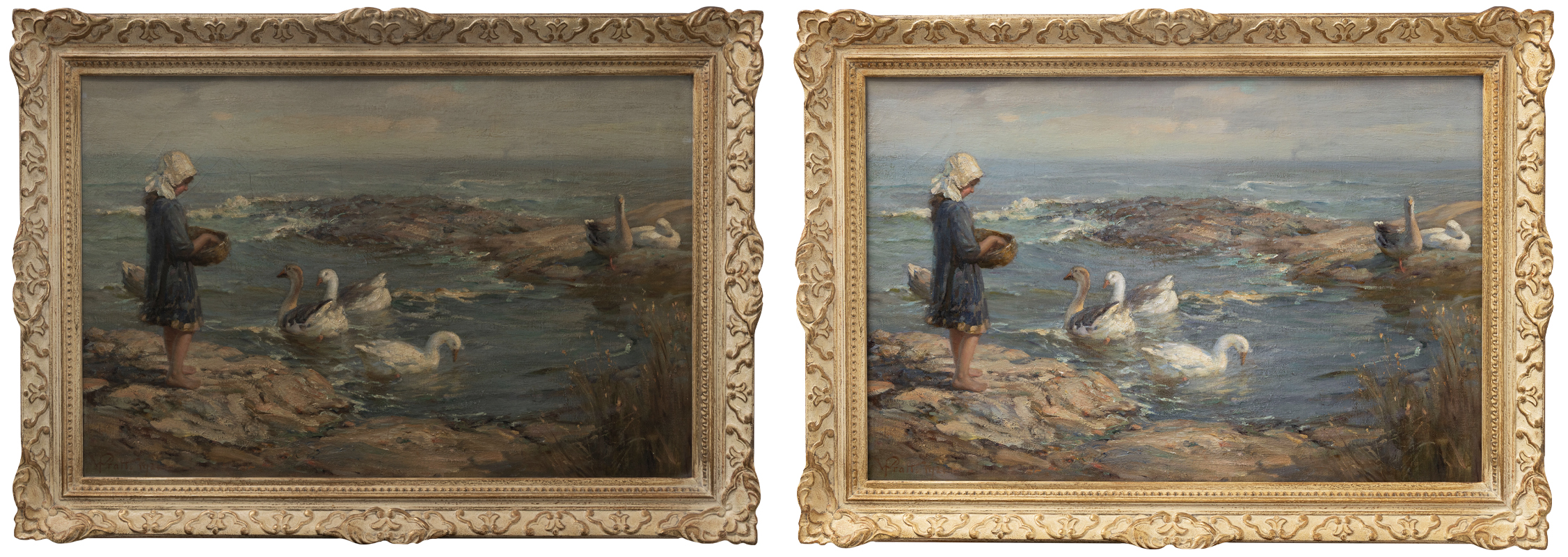
Painted in 1921, William Pratt’s Feeding the Geese captures a young girl barefoot at the edge of shallow water, scattering food for the geese gathered around her. Her bonnet shades her face and her dark dress stands against the muted blues and greys of the water. Some of the birds paddle through the shallows while others wait on the rocks and, beyond them, small waves break across the sea.
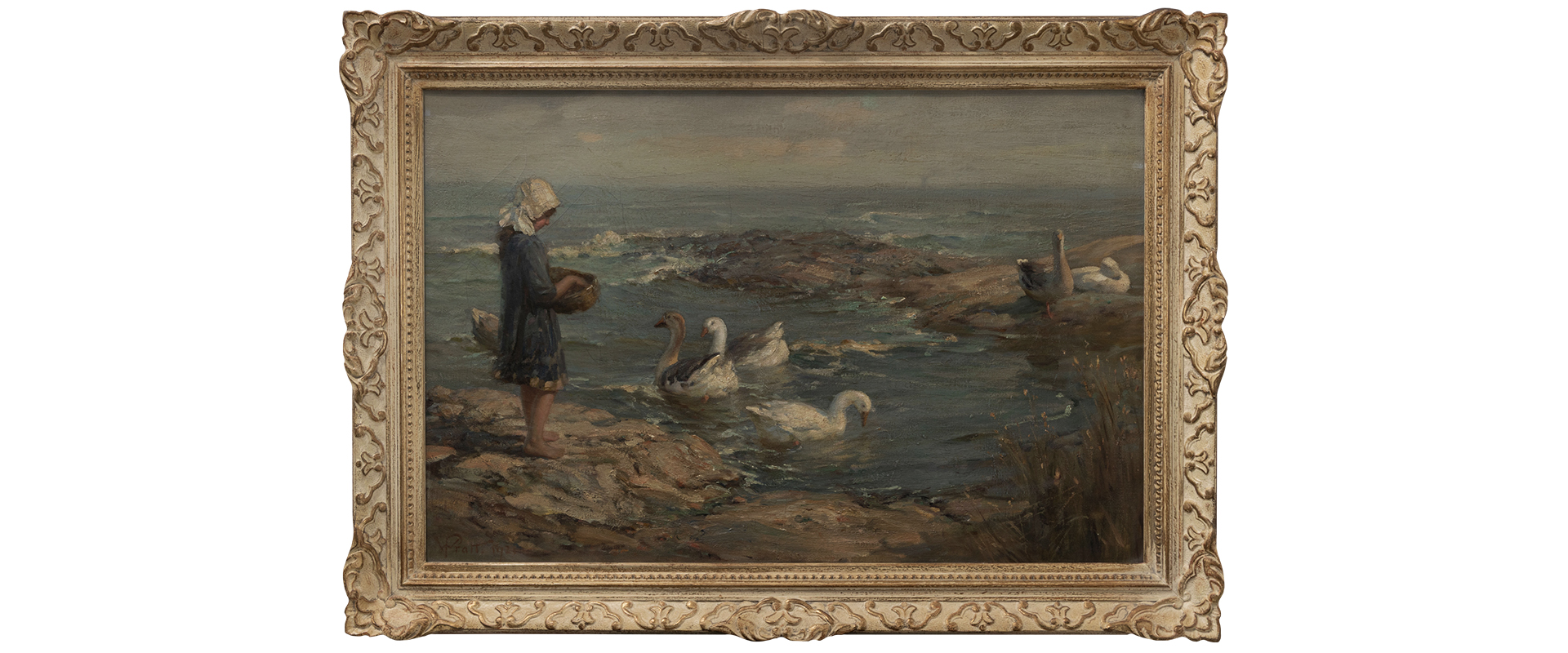
It is an unhurried scene, with little to distract from the simple interaction between the girl, the birds and the landscape around her. More than a century after it was painted, this sense of calm was what immediately appealed to its new owner, when he discovered the painting at auction.
“When I saw it for sale it struck me, it’s very calming to look at.”
As the painting arrived, however, it did not have quite the presence he had expected from the auction photographs. The colours appeared noticeably dull and subdued. Even with lights positioned above and below it, our client felt that much of its colour and vitality had been lost.
Our conservators were tasked with carefully addressing these changes, preserving the painting and allowing the qualities of Pratt’s original work to be appreciated once again.
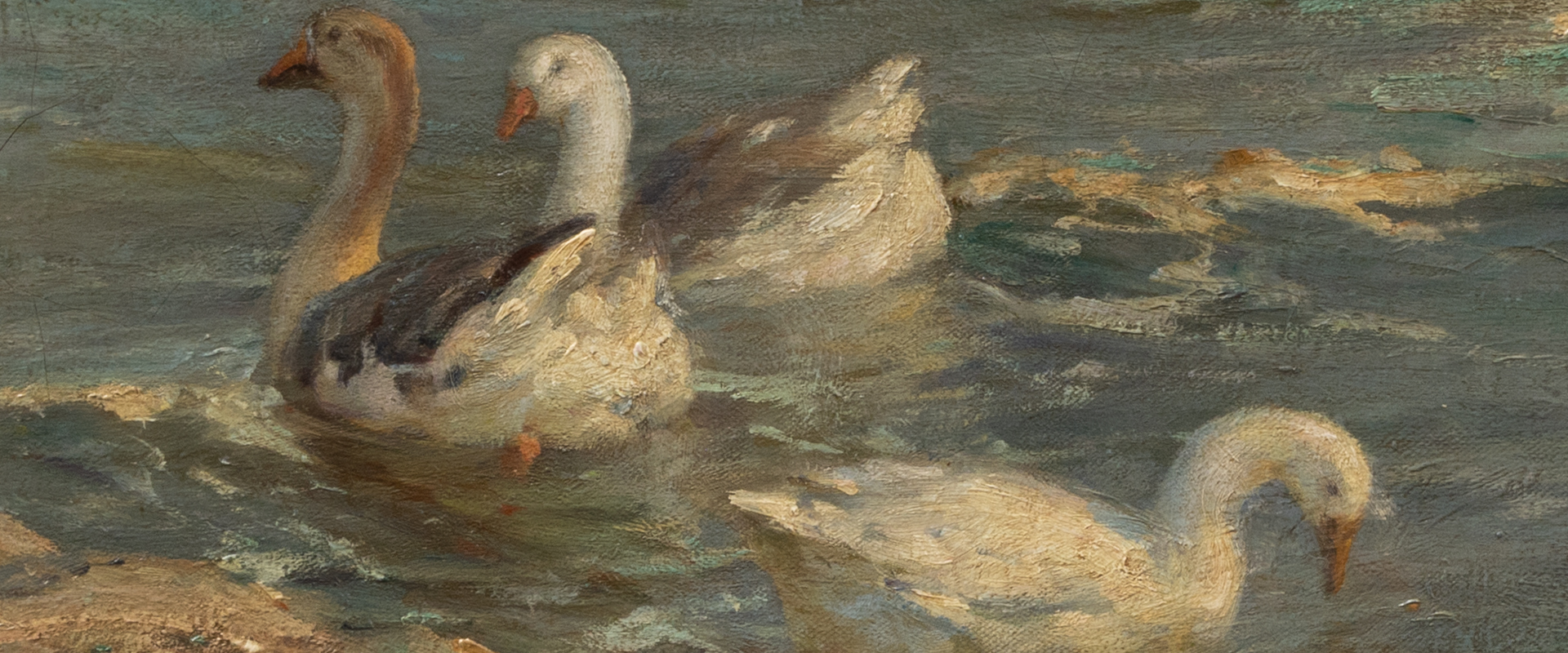 Above: a detail of the painting before treatment
A Changing Picture of Childhood
At first glance, Feeding the Geese is an uncomplicated scene. Yet viewed in the context of its age, the calm atmosphere takes on a deeper significance.
Childhood in Britain had changed considerably over the preceding century as legislation gradually restricted child employment and expanded access to education. Ideas about what childhood should look like were shifting towards greater freedom and protection of innocence.
 Above: a group of children in the early 1920s
The Education Act of 1918 raised the school leaving age in England and Wales from twelve to fourteen and abolished fees in state schools. Remaining exemptions were removed in 1921, the very year Pratt painted Feeding the Geese, strengthening the expectation that children should remain in education rather than enter gruelling roles of employment.
Against this changing backdrop, Pratt’s young figure takes on an added resonance. She is not shown at work or burdened by responsibility. Instead, she is simply allowed to be a child: standing barefoot at the water’s edge, watching the birds and passing the time by feeding them. Even this small act suggests a degree of comfort that might have once been unobtainable – she has food enough to spare for the geese.
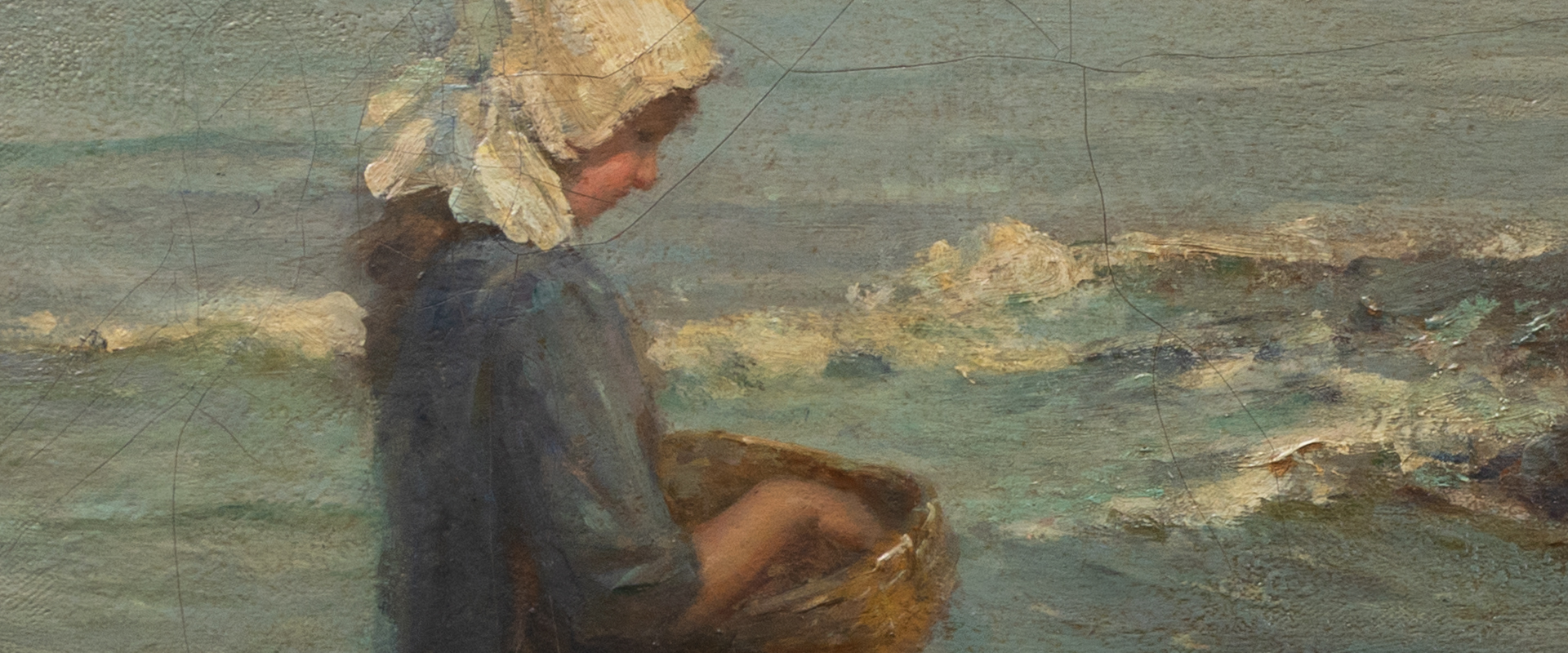 Above: a detail of the painting before treatment
The scene captures well the gentle ideal of childhood that was taking shape in the 1920s. It is this same sense of freedom and tranquillity that gives the painting much of its appeal today. For an afternoon at least, there is nowhere else this child, or the viewer, needs to be.
A Century of Age: Assessing the Painting’s Condition
Before treatment began, our conservators carried out a detailed assessment to understand both the structural condition of the painting and the reasons behind its subdued appearance. Encouragingly, the painting was structurally stable but its surface told a more complicated story.
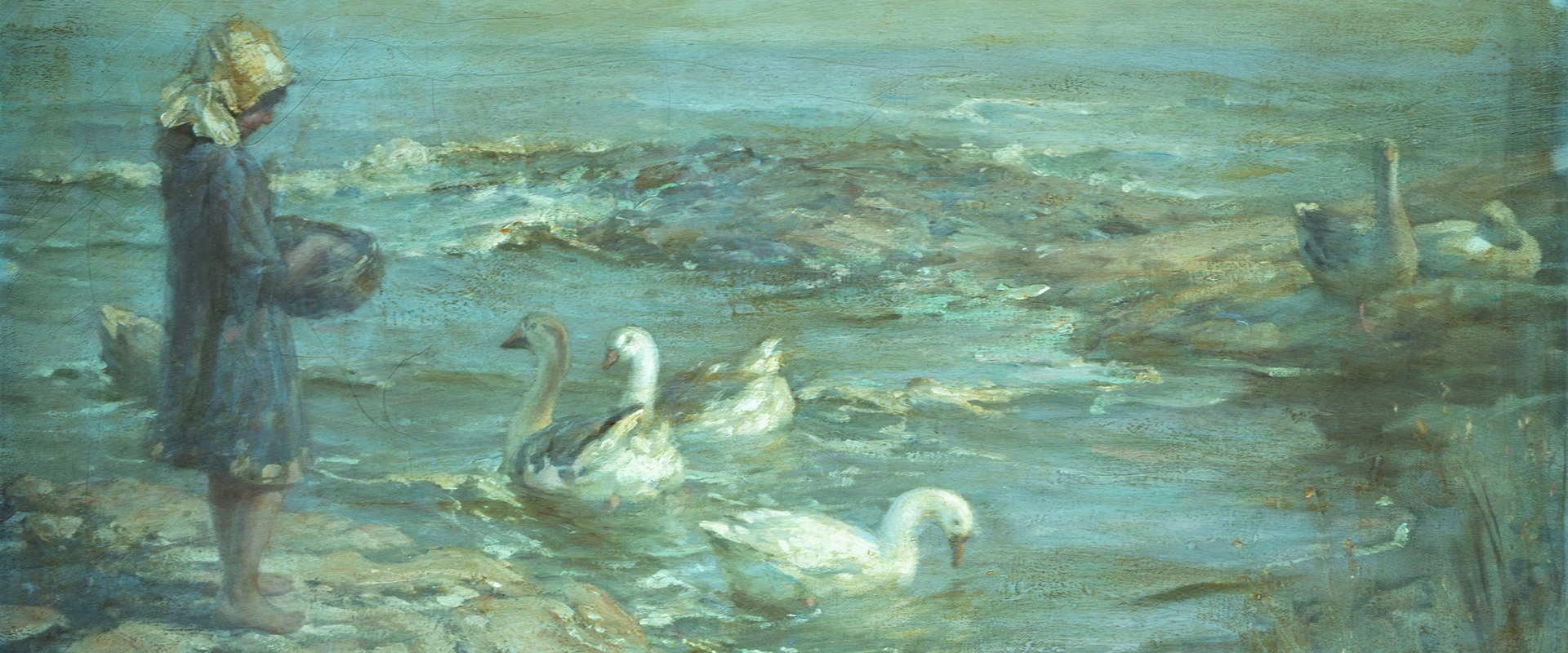 Above: the painting examined under UV light, showing no sign of over-paint but thick layers of discolouration
A yellowed layer of surface soiling had accumulated across the painting, settling into the textured areas of impasto. Dust was present on both the front and reverse and the varnish showed signs of ageing.
Across the upper third of the composition was notable craquelure – the network of fine cracks that can develop naturally as an oil painting ages. Although this cracking appeared stable, some of the darker and larger lines had become visually distracting, particularly around the figure.
Below shows the painting examined under raking light. By using an angled light, we can see raised areas and deformations in the canvas to be aware of before treatment begins.
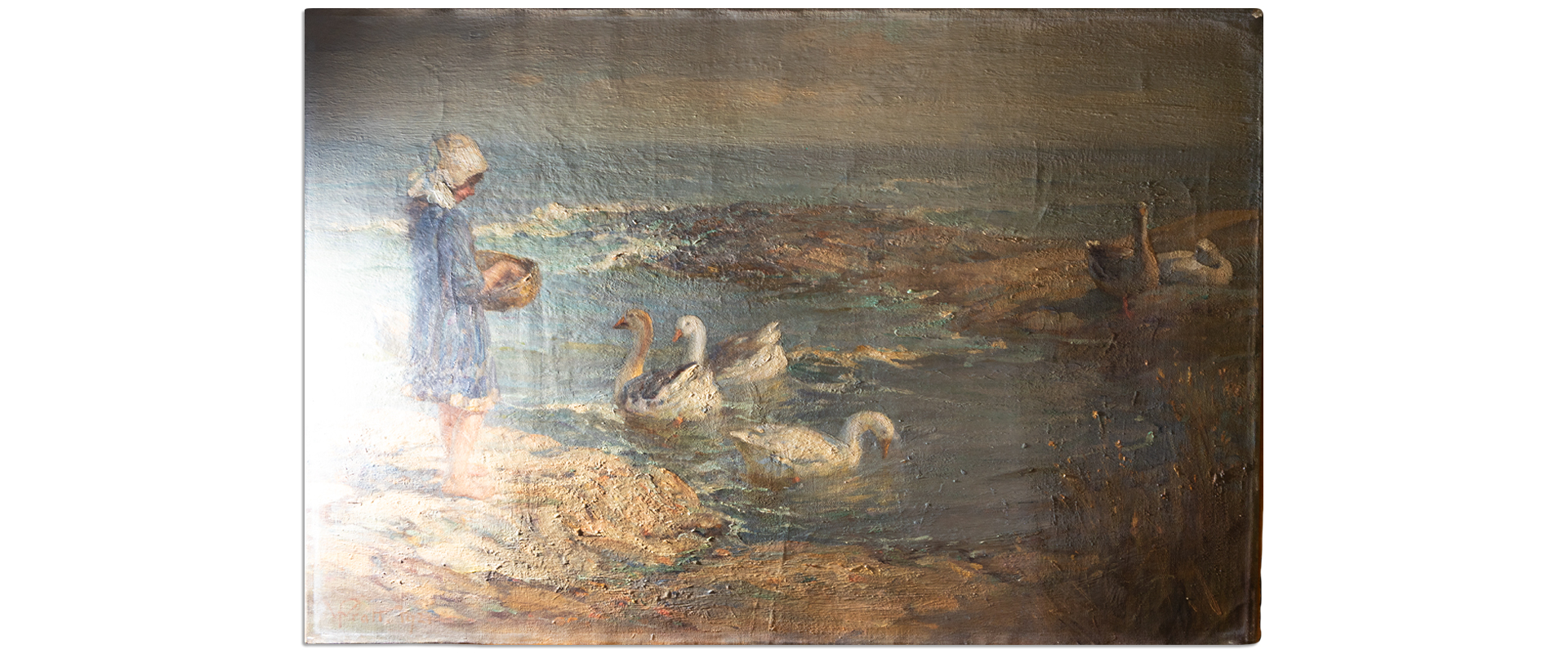
The conservation treatment therefore had two interconnected aims: to protect and stabilise the painting for the future while recovering a more balanced impression of Pratt’s original composition.
Preparing the Painting for Conservation
Before any cleaning could begin, the painting needed to be carefully prepared. Dust and dirt were removed from the reverse of the canvas and from behind the stretcher bars, preventing this material from transferring back onto the painted surface. The canvas was also correctly re-tensioned to support its long term preservation.
The paint layer was consolidated where required, helping to ensure that there was no vulnerable lifting or flaking before further treatment took place.
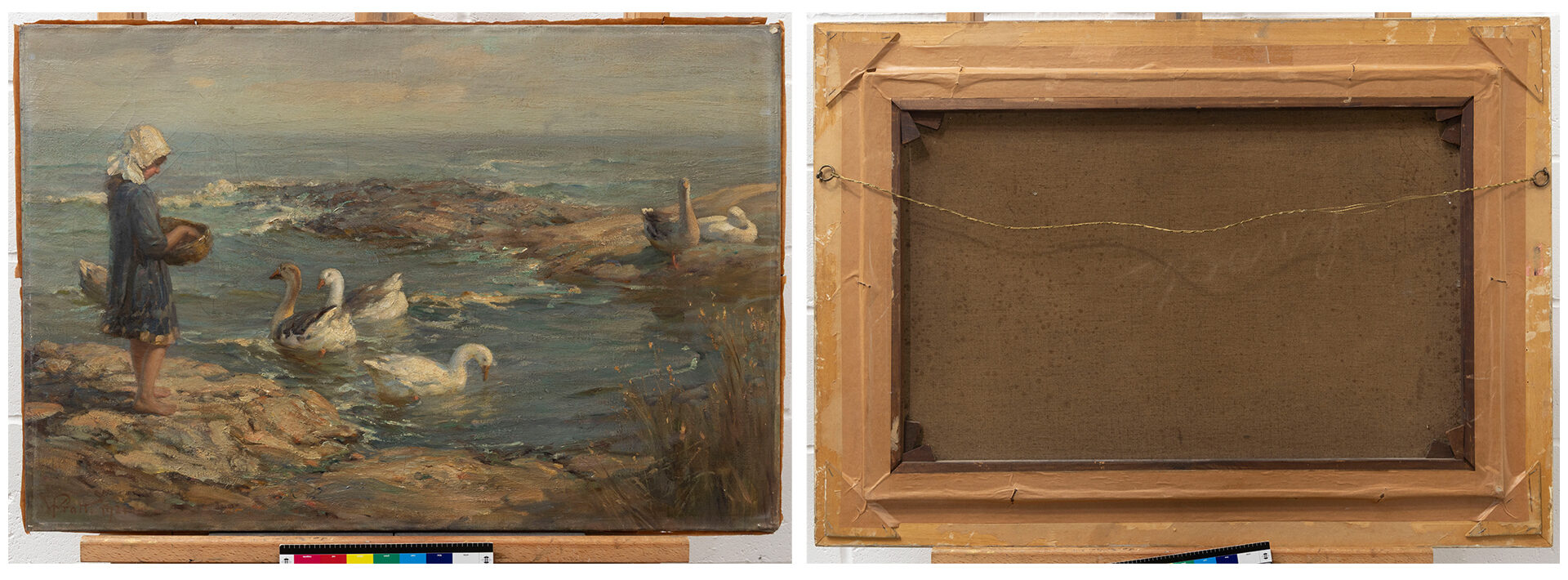
Cleaning a historic oil painting is never a matter of applying a standard solution. Our conservator carried out a range of solvent tests to establish how the different materials responded and determine the most conservation-appropriate approach for this particular painting.
This testing stage allowed the treatment to be tailored specifically to Feeding the Geese, carefully distinguishing unwanted dirt and aged coatings from the original painted surface beneath.
Revealing the Colour
The painting then underwent dry cleaning followed by an aqueous surface clean to address the yellowed layer of soiling. The existing varnish was also removed.
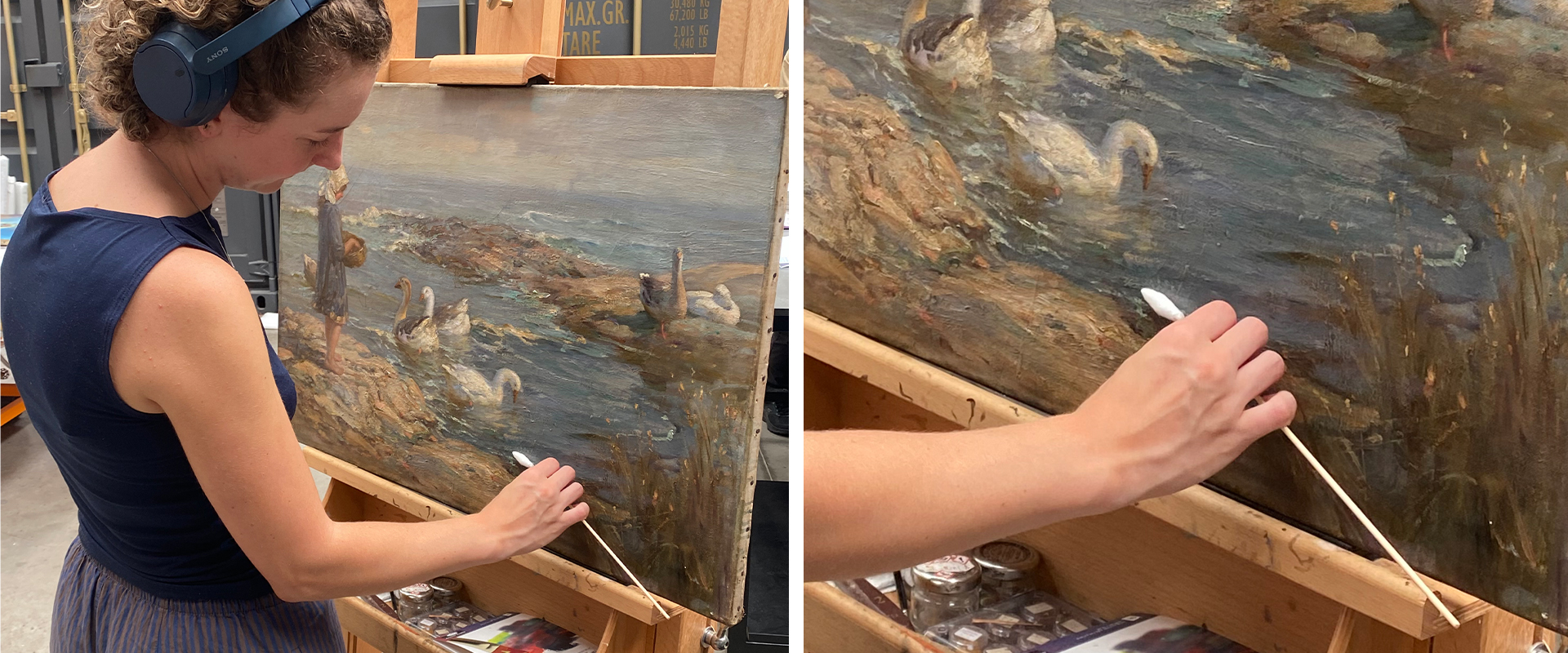
As these accumulated layers were reduced, the visual balance of the painting began to change. Colours that had appeared muted became clearer and the scene regained a brightness and depth that had been obscured over time.
This was the transformation our client had hoped for when he first contacted us. The intention was not to make the painting look artificially new, but to allow Pratt’s original palette, tone and handling of the scene to be appreciated clearly again.
Addressing the Cracks
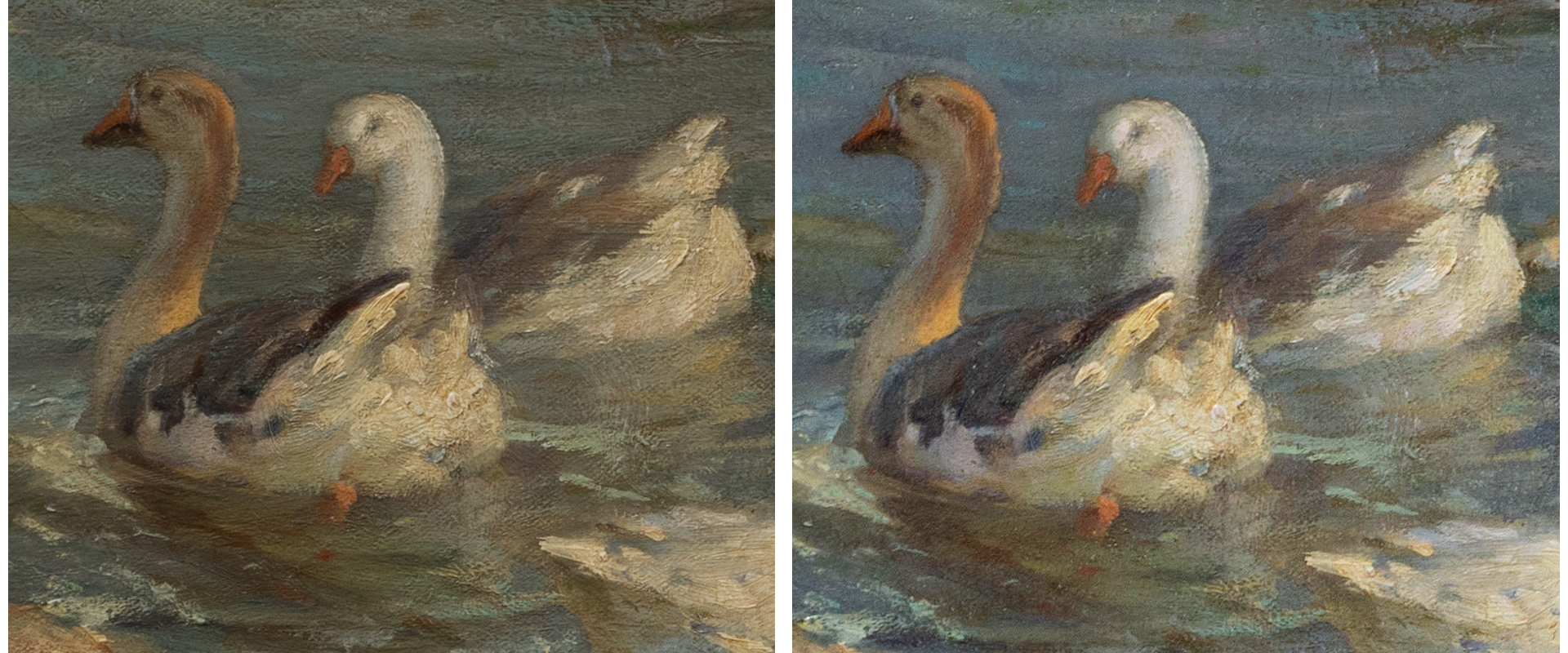
The cracking presented a different challenge. Age-related craquelure is part of the physical history of many oil paintings and complete concealment is neither always possible nor necessarily desirable. In this case, however, several larger dark lines were interrupting the composition and drawing attention away from the scene itself.
Following cleaning, our conservator selectively retouched the larger and most visually disruptive areas of craquelure. The aim was to create a more cohesive image while retaining the integrity and age of the original painting. Particular attention was given to cracking around the girl’s head, an area that had especially concerned our client.
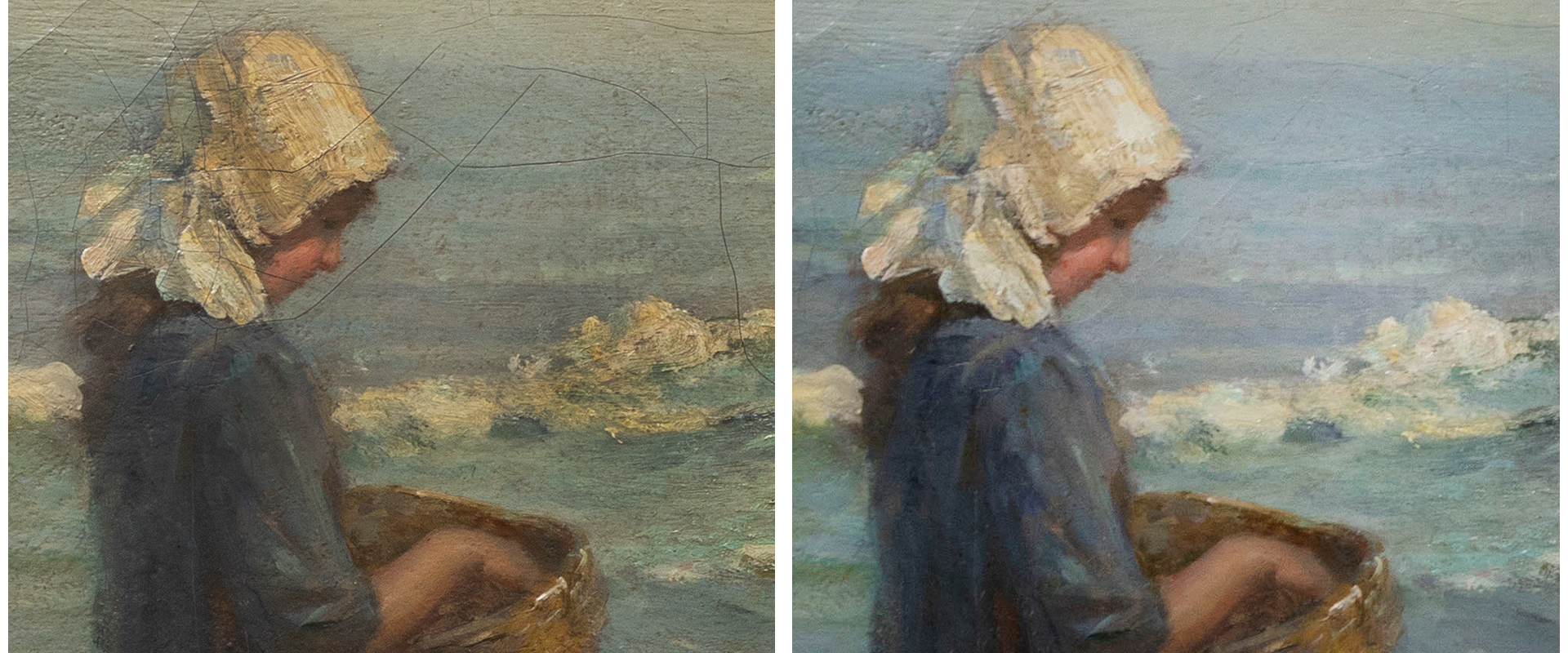
Finally, the painting received new varnish, completing the conservation treatment and bringing greater visual unity to the surface.
Rediscovering The Scene
When the painting returned home and was rehung, the tranquillity that had first drawn its owner to the scene could once again be fully appreciated.
“The painting looks so much better, brighter and the most obtrusive cracks obscured.”
– Client feedback
More than a century after Pratt painted this quiet moment at the shoreline, Feeding the Geese still carries a powerful sense of nostalgia for life’s simpler pleasures.
Preserved for the future, the painting can continue to tell its story of childhood as Pratt composed it in 1921, unhurried and carefree.
About The Artist: William Pratt
William Pratt (1855–1936) was born in Glasgow and became known for his oil paintings and watercolours of landscapes, marine subjects and figures. He trained at the Glasgow School of Art and the Académie Julian in Paris before developing a successful exhibiting career in Britain and France.
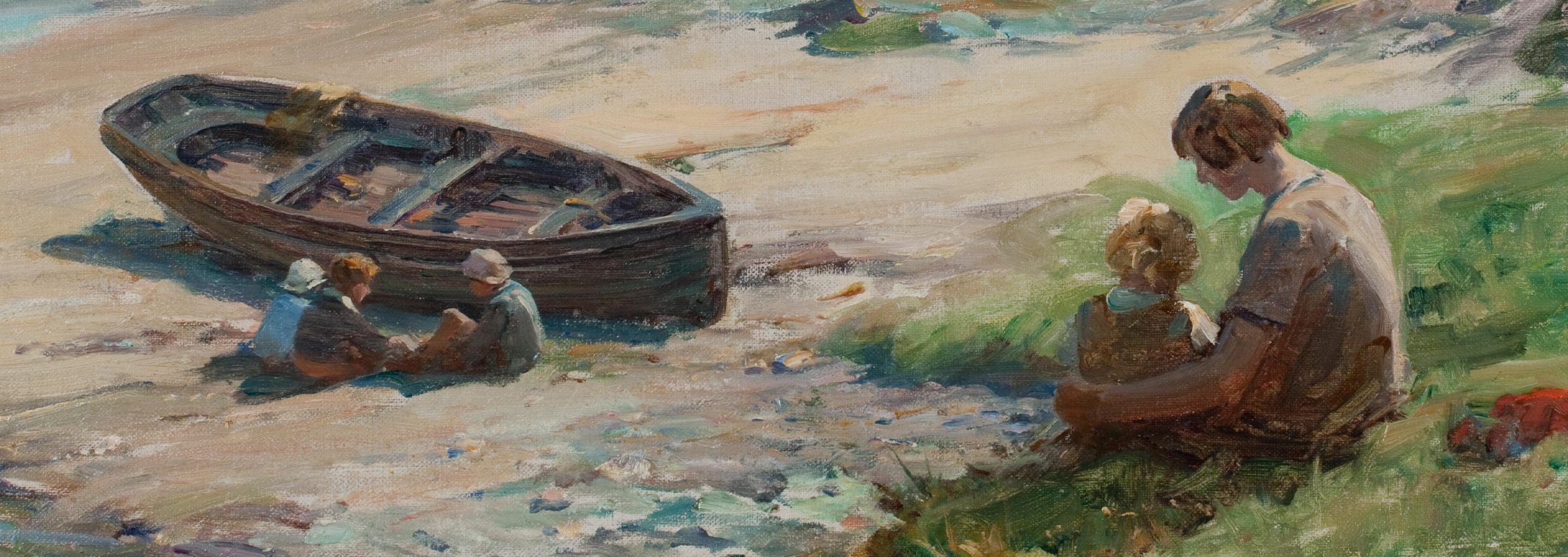 Above: detail from Portrigh Bay, Carradale by William Pratt, 1927
For several years Pratt lived in Crail, where his fascination with the Scottish coast led him to build a studio on the shore at Kilminning. Between 1892 and 1894, he devoted himself particularly to painting the sea, although his talents extended well beyond marine subjects. He was also an accomplished figure painter and was awarded a bronze medal for The Old Covenanter at the Edinburgh Exhibition in 1886.
His exhibition record was extensive. Pratt showed 64 works at the Royal Scottish Academy, 161 at the Glasgow Institute and 23 at Liverpool’s Walker Gallery, alongside appearances at the Royal Academy and Royal Society of Watercolour Painters.
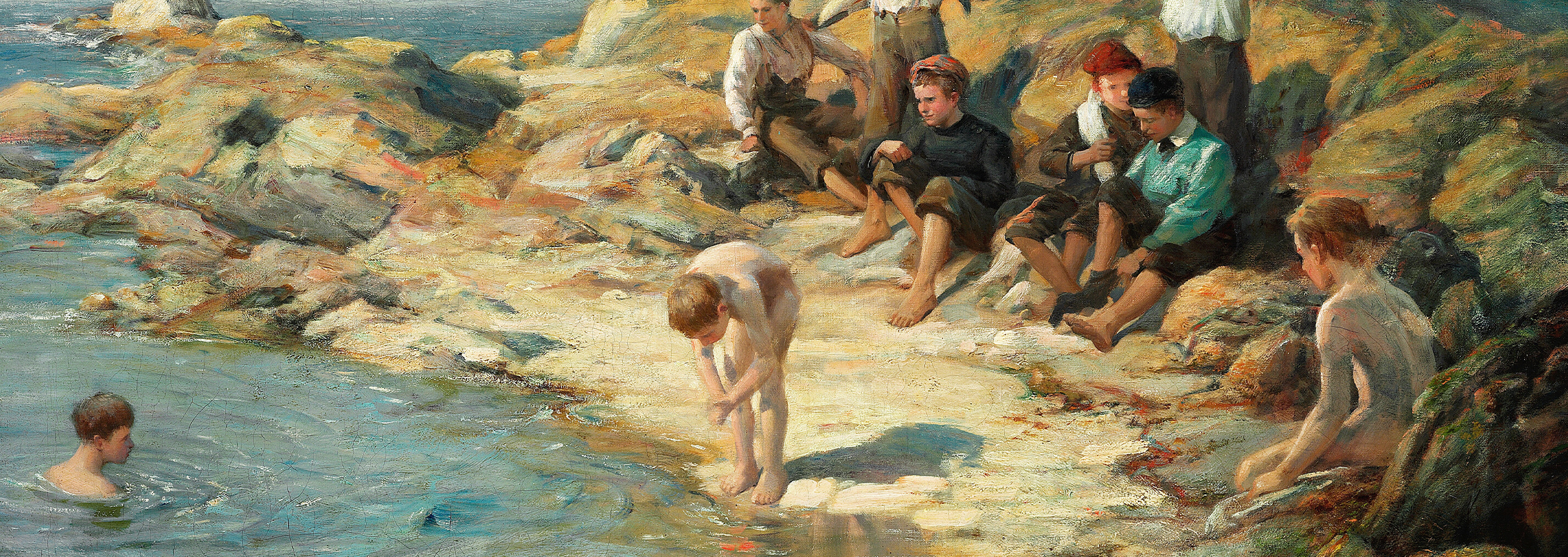 Above: detail from Boys Swimming at a Rocky Coast by William Pratt, 1899
He became particularly associated with scenes of Scottish country life, placing figures in both interior and outdoor settings and approaching his subjects with directness and simplicity. One review described him as “an accomplished craftsman who painted with vigour and brought complex material together with considerable skill.”
In Feeding the Geese, Pratt’s abilities as a figure, landscape and marine painter come together particularly naturally. The child provides the quiet human focus while the rocks, birds and moving water create the environment around her.
Preserving Your Own Piece of History
Every painting has its own history and, with time, changes such as surface dirt, discoloured varnish, cracking or fading can begin to alter how it is experienced.
If you have an oil painting that has lost some of its original clarity or you are concerned about its condition, our conservators can assess the artwork and advise on the most appropriate approach for its care.

Contact Our Team
Speak to our team today to discuss your restoration project and discover how we can help with an assessment and estimate.
We also offer nationwide collection and delivery, as well as guidance on worldwide shipping to our studio.
