 WhatsApp us
When a treasured porcelain figure is accidentally smashed into dozens of pieces, the first question is often whether it can ever be successfully restored, particularly when the damage appears extensive.
Could an ornament that is so badly broken ever be put back together with a good result?

For the owner of this Royal Worcester figurine, there was an additional concern. The figure was pure white and highly glazed, with no colourful decoration or pattern to distract from repaired break lines. It arrived with our conservation team several years after the accident. Most of the original fragments had fortunately been retained, but extensive breakage ran across the figure, including through its head, limbs and flowing dress.
In this case study, we follow its transformation from a collection of fragile fragments back into a complete Royal Worcester figure, exploring the particular challenges of restoring white porcelain and the specialist techniques used to carefully reconstruct, fill, colour match and finish the damaged areas.
If you have a broken porcelain figurine or sentimental ceramic that appears beyond repair, our objects conservators can assess the damage and advise on the possibilities for restoration. Contact us via the form below or email info@fineart-restoration.co.uk
A Treasured Royal Worcester Dancer
Long before it arrived at our studio in pieces, this Royal Worcester figurine had become far more than a decorative object. It had significant sentimental value to its owners, making the possibility of bringing it back together particularly important after it was accidentally smashed several years earlier.

The figure is Royal Worcester’s Dancing Waves, model 3225. It was designed by Freda Doughty, one of the factory’s best-known modellers. Introduced in 1938, the design captures a young dancer poised above swirling waves, her outstretched arms and flowing dress giving the porcelain an unusual sense of movement.
Dancing Waves is more commonly encountered with colourful painted decoration (seen above), but this example has a striking pure white finish. It connects the figure to a much longer tradition of monochrome porcelain, from the celebrated Chinese blanc de Chine of Dehua to Worcester’s own 19th century white sculptural ceramics and Parian wares. Royal Worcester produced many blanc-de-chine versions of figurines, including models by Freda Doughty.
Below you can see examples of traditional blanc de Chine porcelain – all of these pieces would require precise conservation treatments following damage due to their clear finish.

Without painted decoration, the modelling itself takes centre stage. Light moves across the glossy porcelain, picking out the folds of the dancer’s dress, the movement of her body and the curling waves beneath her feet. For its owners, these were the familiar details that made the figure recognisable and worth saving.
The very qualities that make this white version so striking would also make its restoration particularly challenging. Once shattered, there was no pattern or colourful decoration to draw the eye away from the damage. To return this sentimental figure to display, the many repaired joins would need to sit convincingly within an uninterrupted expanse of brilliant white porcelain.
Piecing the Figurine Back Together
Before bonding began, the individual fragments were carefully cleaned, examined and organised. With an object broken into so many pieces, reconstruction has to follow a considered sequence. Bonding one section too early can prevent another fragment from fitting correctly later, particularly across a complex three-dimensional form.
The fragments were gradually reunited using an appropriate conservation-grade adhesive, rebuilding the dancer and the elaborate waves beneath her.

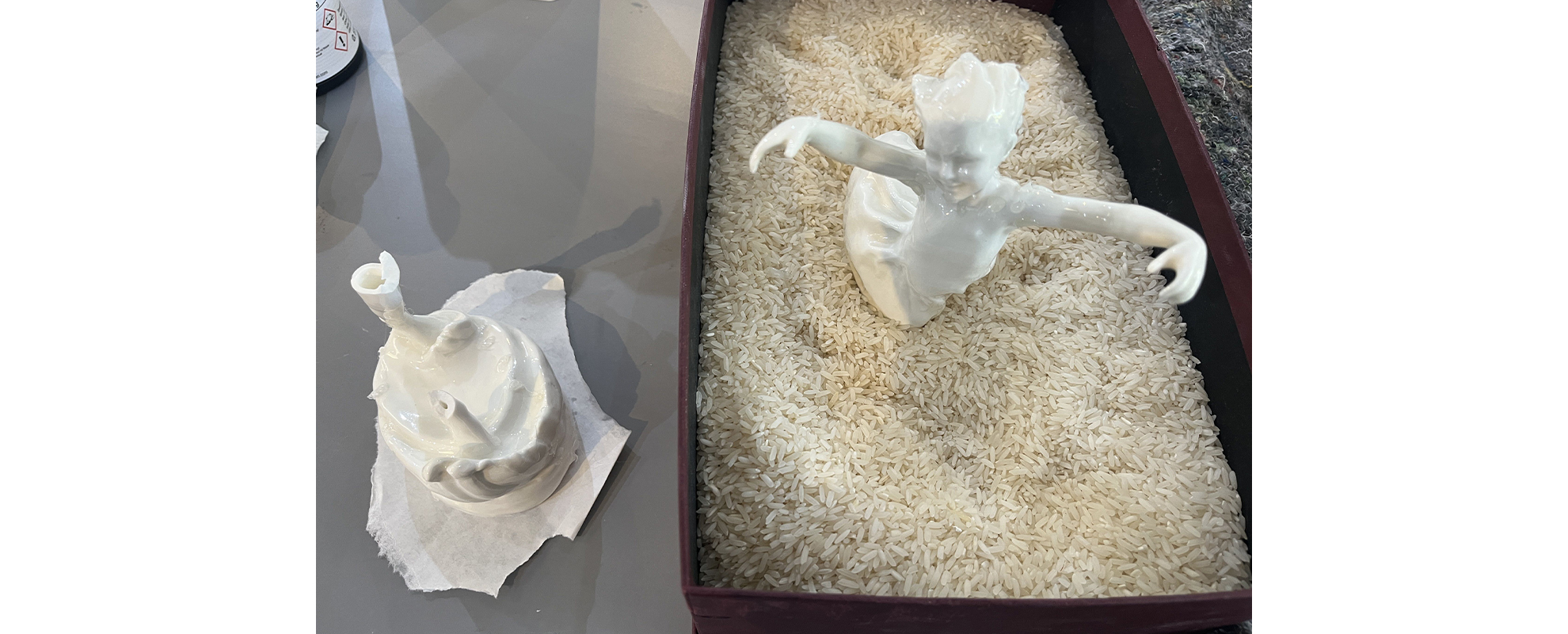
During treatment, the partially reconstructed figure was supported in a container of clean, dry rice. Although it looks unconventional, this provides a safe and adaptable support around an item whilst it is being treated, helping to hold projecting limbs and irregular sections without pressure or abrasion while joins are positioned and bonded.
Accurate alignment at this stage was particularly important to the eventual appearance. Even a very slight difference in level between two pieces could catch the light across the glossy white surface and make a break line more apparent once treatment was complete.

Blending the Break Lines
Once the surviving fragments had been reunited, attention could turn to the many small losses left along the break lines.
When porcelain shatters, minute slivers can be lost from the edges of fragments. This means that even when almost every recognisable piece has been retained, narrow gaps may remain once everything is fitted back together.

These areas were carefully filled and the fills refined to follow the original contours of the porcelain. This was especially important around areas such as the dancer’s face, limbs and flowing dress, where an irregular repair could disrupt the modelling of the figure. The small fills were then retouched, matching the surrounding white as closely as possible.
Colour matching alone was not enough for a clear result. Dancing Waves had a highly glazed surface, so matte repairs would remain apparent even if their colour were correct. A gloss layer was therefore applied to the treated areas, with the surface texture and reflectivity matched as closely as possible to the surrounding porcelain.

Together, these stages helped reduce the visual interruption caused by the network of breaks without altering the original white finish of the figurine.
Returning “Dancing Waves” to Display
The completed restoration provides a particularly good answer to the question posed at the beginning of the project.
A badly smashed white porcelain figurine can be restored with a remarkably successful visual result, but achieving that result involves much more than simply joining the broken pieces.

The feedback we received also reflected how personally important pieces like this can be:
“I was completely bowled over when I opened my birthday present from my husband! I thought that I’d lost my precious ‘dancing girl’ forever when she smashed into a hundred pieces, and there by some miracle she was, in one beautiful piece!
I just wanted to say a personal big thank you for bringing her back to life for me. You are amazing and I simply cannot fathom how you did it! It has truly meant the world to me to have her back.
She was a present from my late father many years ago. He always said that she reminded him of me – I was always running and dancing and doing handstands in the garden – and I was heart broken when she was knocked off the shelf.
I still haven’t quite got over the joy and shock of seeing her again. It’s a wonderful feeling and it’s all down to you, so thank you again.”
Following treatment, the figurine could once again be appreciated as a complete sculptural composition. The dancer’s body, billowing dress and curling waves flow together again, allowing the modelling of the brilliant white porcelain, rather than the extensive accidental damage, to become the focus.

For an object of considerable sentimental significance, this was particularly important. Restoration is not always determined by financial value. Porcelain figures, ornaments and ceramics are often treasured because of the people and memories associated with them, and even severe accidental damage does not necessarily mean that an object has been lost.
Expert Repairs for Porcelain Figurines
A ceramic object can look beyond repair when it is lying in dozens, or even hundreds, of fragments. Do not discard the small pieces. Even apparently insignificant fragments can be invaluable during reconstruction and may reduce the amount of filling required.

Our specialist objects conservators restore porcelain, bone china, earthenware, stoneware, terracotta and other historic and modern ceramics, including:
- Smashed and extensively fragmented objects
- Cracks, chips and areas of loss
- Damaged glazed and high-gloss ceramics
- Decorative, antique and sentimental objects
- Previously restored ceramics requiring further treatment
Every object is assessed individually so that an appropriate treatment can be developed around its materials, condition and intended appearance. Nationwide collection and delivery can also be arranged for fragile objects that cannot be safely transported by their owners.
If you have a broken porcelain figurine, dish or object, contact our team with photographs of the object and its fragments for an initial assessment.
