 WhatsApp us
This early 20th century landscape depicts the countryside surrounding Hämelschenburg Castle in Lower Saxony.
When its owner discovered the painting at auction, its significance was particularly personal: the artist was his great-grandfather. However, more than one hundred years after it was painted, the landscape was showing its age.
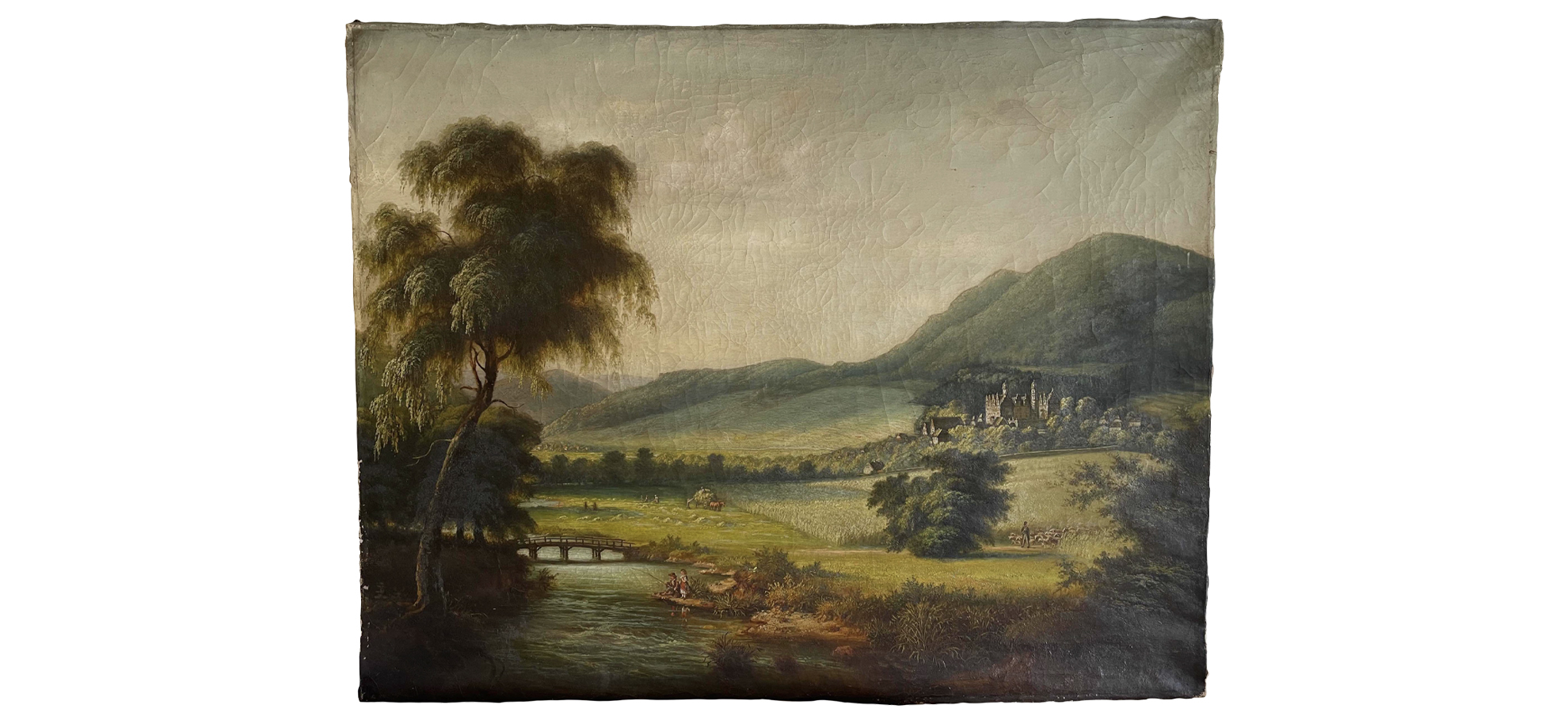
The canvas had become slack and distorted, extensive cracking covered the painted surface and accumulated dirt obscured much of the detail. Most concerningly, areas of paint were beginning to become unstable.
For its owner, the priority was never to make the painting look new. It was to preserve something that had unexpectedly brought a piece of his family’s history back into his life.
 Above: one of our easel painting conservators working in the studio
If you have an oil painting with cracking, flaking paint, surface dirt or an unstable canvas, our easel painting conservators can assess its condition and recommend a treatment designed around the artwork, its history and how you would like it to be preserved. Contact us via the form at the end of this page or email info@fineart-restoration.co.uk
Finding a Family Landscape at Auction
The story of this restoration began when the owner discovered the painting at auction and recognised an unexpected family connection. Painted around 1909–10, the landscape was by his great-grandfather, Sigismund Guido Dedo Freydanck, who lived in nearby Hameln.
 Above: a photograph of Hämelschenburg Castle taken in 1918
The painting looks across the countryside of Hämelschenburg in Lower Saxony. Children fish beside the water and cattle graze in the foreground, while the wooded landscape rises towards Hämelschenburg Castle. Dating largely from the late 16th century, the Schloss is an important example of Weser Renaissance architecture and would have been a familiar local landmark to Freydanck.
Although painting was a hobby for him, Freydanck’s composition demonstrates an accomplished understanding of perspective. The castle provides a distant focal point, emerging above the trees without overwhelming the quieter rural scene. Beyond its importance as a family piece, the painting preserves Freydanck’s personal view of a real and recognisable landscape, captured more than a century ago.
 Above: detail of the landscape before restoration
Respecting the Painting’s Age
From the beginning, the client was clear about what he wanted from the conservation work. The network of cracks did not need to disappear and he was particularly keen that original materials should be retained wherever possible. As he explained before the painting arrived:
“I’m keen for the painting to be stabilised while not over-restoring it, and ideally keeping as much of the original material (canvas and stretchers) as possible.”
Once the painting reached our studio, easel painting conservator Sabrina was able to carry out a detailed assessment. What initially appeared from photographs to be predominantly extensive craquelure proved to be a more complex conservation project.
 Above: a detail of the deteriorating surface
The cracking was particularly pronounced across the sky and around the outer edges. There were areas where paint had already been lost, the canvas lacked adequate tension and three stretcher keys were missing.
Layers of dirt had accumulated over time, together with fly deposits and even food splashes. Evidence on the reverse also suggested that somebody had previously attempted to stabilise the cracking using a paste-like adhesive.

Analysing the Surface
Before treatment began, the painting was examined closely to understand the condition of both the painted surface and the canvas beneath. Alongside examination in normal light, specialist techniques including UV and raking light helped our oil painting conservator Sabrina identify features that could be difficult to see under ordinary viewing conditions.

Raking light, directed across the painting at a low angle, highlighted the extensive craquelure, raised areas of paint and distortions in the canvas. UV examination provided further information about the surface, helping to distinguish the varnish and identify areas that may have been altered or treated previously.
Stabilising a Heavily Cracked Oil Painting
Cracking, or craquelure, is common in historic oil paintings. Canvas, paint and varnish naturally age at different rates, while fluctuations in temperature and humidity can cause the canvas to expand, contract or lose tension. As older paint becomes less flexible, this movement can contribute to networks of cracks across the surface.
 Above: our conservator consolidating a cracked painting surface in our studio
Craquelure is not always problematic and can form part of a painting’s natural character. In this case, however, areas were lifting and becoming vulnerable to paint loss, making stabilisation essential.
Sabrina consolidated the vulnerable paint before controlled heat, weight and moisture treatments were used to address distortions in the canvas. Missing stretcher keys were replaced and the canvas was re-tensioned to provide better support for the paint layers.
Sensitive Cleaning Techniques
Once the paint layer and canvas were secure, attention could turn to the accumulated dirt obscuring the landscape. The surface had collected significant soiling over time, including dust, fly deposits, food splashes and residues associated with historic repairs.
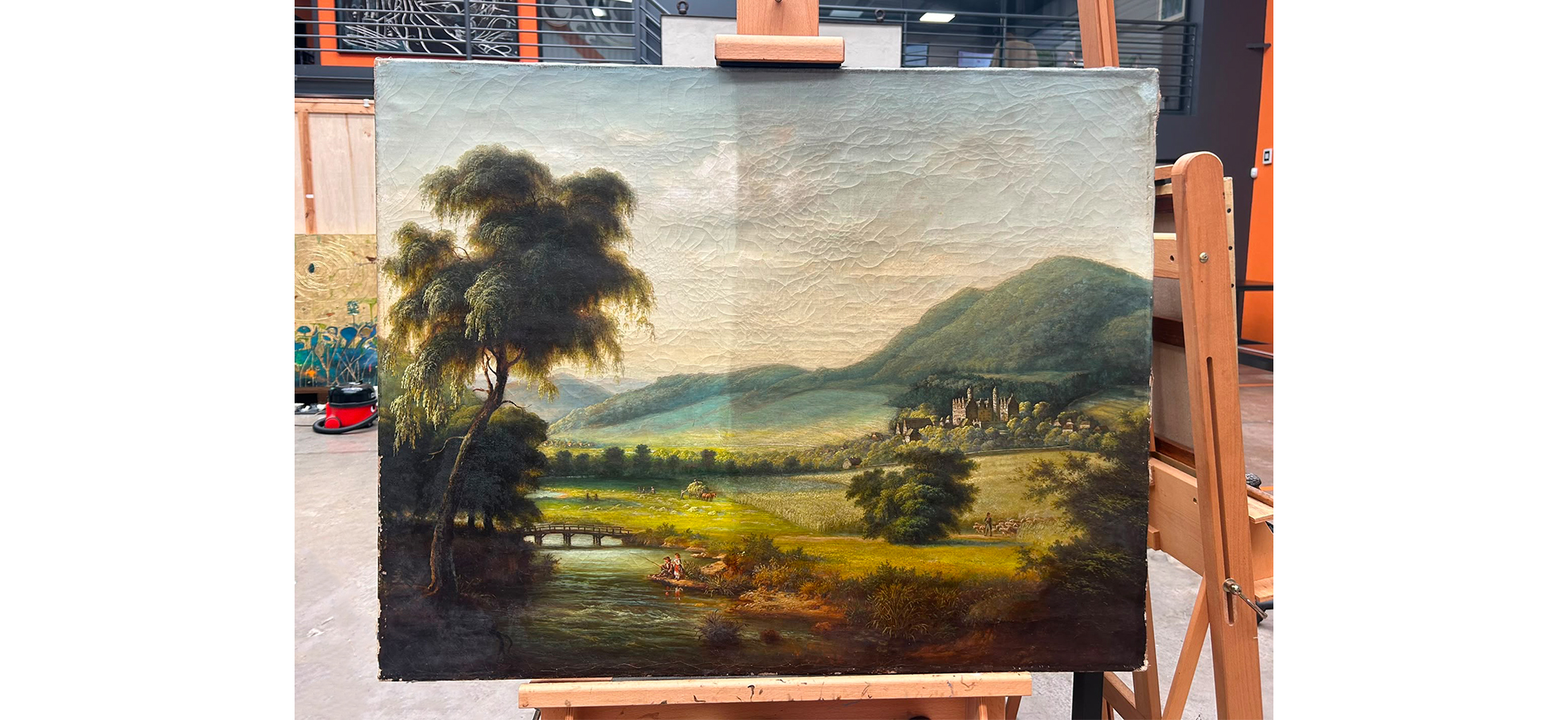
Before cleaning, our team carried out careful testing to establish a solution suited to the individual materials of the painting. This allowed the surface contamination to be gradually reduced while preserving the original paint layer.
As cleaning progressed, the transformation was particularly noticeable. Colours became clearer and previously obscured details began to reappear throughout the composition, bringing greater depth to the river, figures, vegetation and distant architecture.
Following cleaning, areas of genuine paint loss and the most visually disruptive cracks were sensitively reintegrated before a final conservation varnish was applied.
Seeing the Landscape Again
The owner remained closely involved throughout the process and later travelled to our studio to see the painting and meet the team.

By then, the difference was considerable. Yet the aim had not been to erase the painting’s century of history. Its craquelure and aged character remained part of the surface, while the structural problems had been addressed and the colours, depth and smaller details of the landscape could once again be appreciated.
“From start to finish, Jenny, Sarah, Katy and all the team did a perfect job with restoring a difficult oil painting, and I cannot commend them highly enough.
I had discovered the large landscape, painted by my great-grandfather in 1910, in an auction and managed to purchase it. The frame was missing, the canvas had warped, and the paint was heavily cracked and starting to fall off. It was also very dirty and looked to have been kept in a shed or loft for some years.
The team managed to flatten and restretch the canvas, repair the stretchers, stabilise the cracking, and clean off multiple layers of dirt, varnish, and insect and food traces (!), leaving it looking fresh and glowing, yet with its antique character entirely intact.
They did a thorough investigation initially, providing a full report, and allowed us to visit and meet the restorer, which was fascinating. A huge factor is the professional collection and delivery service, which took a lot of stress out of the process.
They are clearly trusted by a number of major institutions, and I would encourage anyone with an important piece of art that needs work done professionally and sensitively to contact them.”
The painting could now return home not as a newly revived object stripped of its age, but as the same family landscape – stabilised, clear to see and ready to be enjoyed again.

Professional Oil Painting Conservation
Every historic painting brings together its materials, condition and individual history. Whether a work has extensive craquelure, a loose or distorted canvas, flaking paint, historic repairs or decades of accumulated surface dirt, treatment should begin with understanding what the painting actually needs.
Our easel painting conservation team provides specialist assessment and restoration for historic, modern and contemporary oil paintings, with treatment tailored to preserve as much original material as possible.
If you have a family painting, inherited artwork or historic landscape in need of conservation, contact our team for an initial assessment and specialist advice.
Contact Our Team
