WhatsApp us
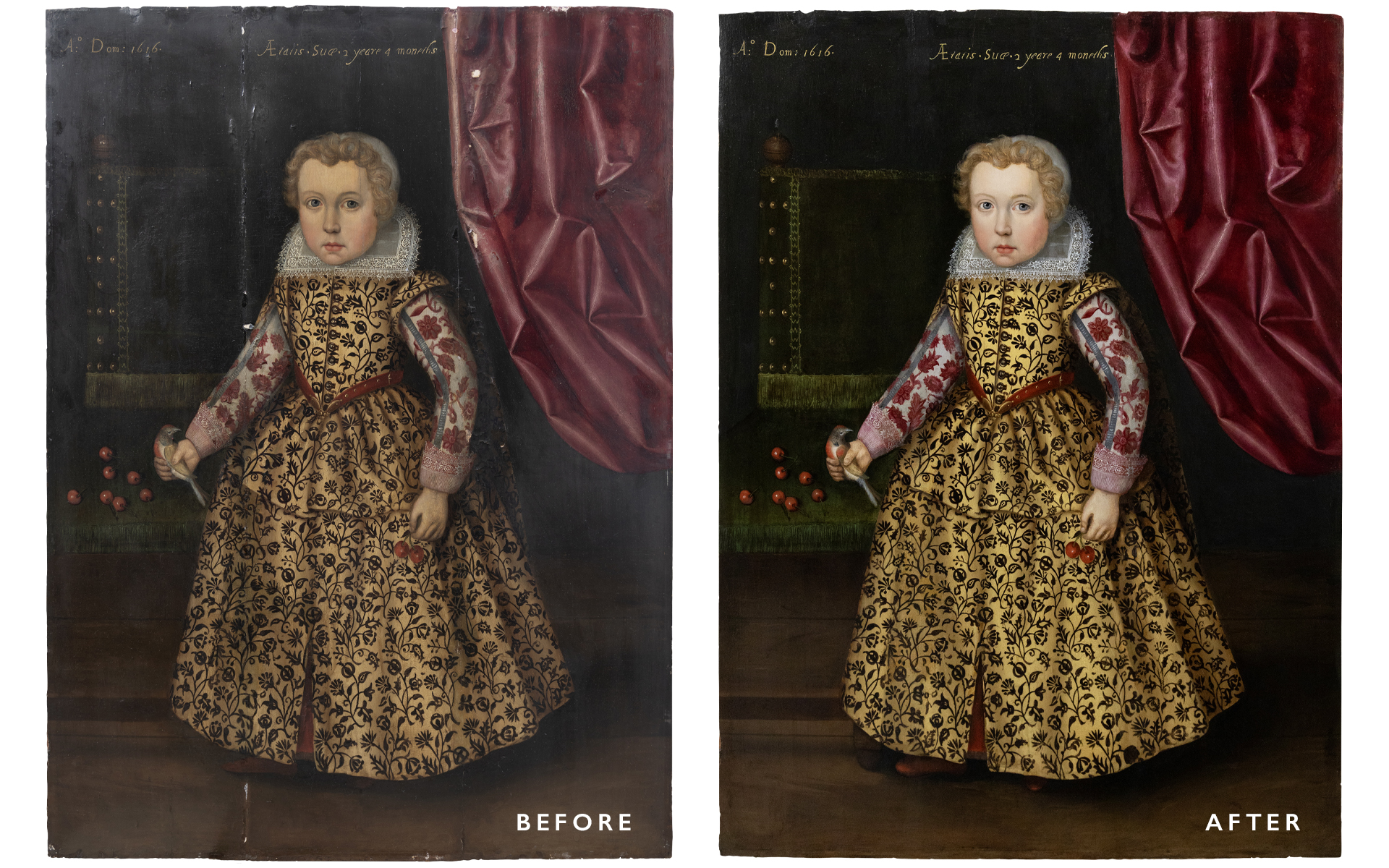
Painted during the reign of James I, this remarkable portrait depicts a young boy, dressed in an elaborate gold-patterned gown and lace collar.
The inscription above his head records his precise age: “Ao Dom: 1616 … Aetatis Suae 2 yeare 4 moneths.”
More than four centuries later, the portrait arrived at our studio following its purchase at auction. Attributed to the 17th century Anglo-Dutch School and the Circle of William Larkin, it appeared remarkably complete. Closer examination, however, revealed a much more complicated conservation history beneath the surface.

There is sometimes a misconception that oil painting restoration is primarily an artistic pursuit, centred around recreating missing details. In reality, those stages come much later and are approached far more delicately and ethically than simply ‘repainting’ what has been lost.
Conservation begins with science: understanding how an artwork was made, identifying how its materials have changed and testing how different layers will respond to treatment. For a Jacobean painting that had already undergone extensive restoration, this investigation was particularly important.
 Above: our conservator working on a painting in the studio
From distinguishing original paint from later alterations to uncovering old repairs and reconstructing the intricate pattern of the boy’s golden gown, this project reveals just how much can lie beneath the surface of an historic painting and the expertise required to safely conserve it.
If you have an historic painting in need of specialist care, contact our conservation team for expert advice and an assessment.
A Truly Jacobean Childhood
The sitter was just two years and four months old when this portrait was painted in 1616, placing his birth around 1613. He entered a relatively new Stuart world, only a decade after James VI of Scotland inherited the English throne as James I.
If he survived through childhood, almost all of those formative years would have been spent under King James, who remained on the throne until 1625. The boy captured here can therefore be thought of as a truly Jacobean child. Adulthood would bring a very different England: by his late twenties, the country was descending into Civil War and, by his mid-thirties, Charles I had been executed and the monarchy abolished.
 Above: a view of London in 1616
His appearance places him firmly within this Jacobean world. The elaborate costume reflects the portraiture associated with William Larkin, whose paintings are renowned for their meticulous depiction of luxurious textiles, embroidery and lace.
To modern eyes, the boy’s wide lace collar, floral sleeves and extravagant gold-patterned gown might initially suggest a female sitter. In Jacobean England, however, young boys commonly wore gowns during their earliest years before being ‘breeched’, an important childhood milestone when they first began wearing breeches or trousers.

Gowns were practical for very young children, making toilet training easier and avoiding the complicated fastenings found on contemporary breeches. Breeching generally took place once a boy was old enough to manage these garments himself and could even be celebrated as a small family occasion, marking his progression away from infancy. At two years and four months old, this young sitter had evidently not yet reached that stage.
 Above: a detail from a 1599 painting entitled Rich Children, Poor Parents by Aert Pietersz, showing a boy and girl dressed in gowns
Assessing the Portrait: What Did We Find?
When an historic painting arrives at our studio, treatment does not begin immediately. The first stage is investigation. Our conservators combine close visual examination with techniques such as UV examination, raking light, magnification and carefully controlled cleaning and solvent tests to understand how an artwork was constructed, distinguish original material from later interventions and identify areas of instability.

Generally, the older a painting is, the greater the possibility that previous generations have cleaned, repaired, retouched or altered it. When a 17th century panel arrives in our studio, our conservators therefore know that what is visible on the surface may represent several different periods of its history.
Over the centuries, varnishes may have been added, losses filled, damaged passages repainted and earlier repairs covered by subsequent restoration. Part of the challenge is working backwards through these layers to understand what belongs to the original painting.

In this case, our assessment found:
- A panel constructed from three original wooden boards with a reverse cradle fitted at a later date
- Minor hairline cracking through the panel
- Historic surface dirt to the front and reverse
- A significantly yellowed varnish layer
- Previous filling along the joins between the boards
- Extensive historic retouching and overpainting
- Areas of tenting, cleavage and lifting paint
- Later overpaint extending beyond previous losses and across areas of original material
Although the wooden panel itself remained structurally sound, the paint layers required considerably more attention. UV examination helped distinguish some areas of later restoration from the original surface, while examination under magnification allowed the conservator to study cracking, lifting and the relationship between different paint layers in much greater detail.
 Above: a close-up detail of the surface damage
Small treatment tests were then used to investigate how the varnish, overpaint and retouching responded to different solvent systems before any wider removal was attempted.
Of particular concern were areas of thick overpainting. These later layers had created uneven tensions within the paint structure, disrupting original ground layers beneath and contributing to areas beginning to lift away from the wooden support.
 Above: a detail of the damaged and deteriorating surface during assessment
Together, the imaging, close examination and material testing began to separate the different chapters of the portrait’s physical history. Only once our conservators understood what was original, what had been added later and which areas were vulnerable could a safe treatment plan be developed.
 Above: a detail of an area with lifting and flaking paint
A treatment plan was put together and agreed with the client. The project was expected to require approximately 100 hours of specialist conservation, reflecting both the scale of the previous intervention and the precision required to work safely around the surviving 17th century paint.
Addressing Previous Repairs & Instability
One of the most technically demanding aspects of this project was separating original material from layers of previous restoration. UV examination helped identify later interventions, while small-scale testing established how the aged varnish, retouching and overpainting responded to different solvents.
This allowed the conservator to develop a controlled approach to reducing later material while protecting the historic paint beneath, with particular care required around the red passages and background.

Previous restoration is not automatically removed simply because it is old. Stable and sympathetic repairs can sometimes be retained, but in this case some of the later material was contributing to instability.
Friable and tented original paint first had to be consolidated and flattened and thin cracks stabilised before the discoloured varnish and unsuitable overpainting could be safely addressed. As these layers were gradually removed, the extent of earlier damage became clearer. Long losses followed the vertical joins between the wooden boards, with further losses across the background, curtain and costume.
Treatment photographs from this stage can appear dramatic because the portrait temporarily looks more damaged than it did on arrival. These losses were not caused by conservation; they had previously been concealed beneath fills and overpainting.
This is why treating an historic painting is very different from simply cleaning or repainting it. Original paint, varnish, fills and generations of restoration can exist together on the same surface, each behaving differently. Carefully separating those layers allowed the underlying problems to be treated properly rather than simply adding another restoration over the top.

Exploring the Symbolism
During the treatment, our team was fascinated by the symbolism woven into the portrait, particularly the bird and cherries.
 Above: a detail of the bird held in the child’s hand with loose cherries on the chair in the background
The boy’s clothing tells us something about his age and the world in which he lived, but the objects surrounding him may reveal another layer of meaning. Jacobean portraits were carefully constructed images, and seemingly simple details could carry religious, personal or symbolic associations.
The songbird: Likely a goldfinch, the bird was a popular children’s pet but also carried longstanding Christian associations. Its distinctive red markings connected it with Christ’s Passion and ideas of redemption and salvation, while birds could also represent the human soul. In the portrait of such a young child, these associations take on particular poignancy at a time when childhood mortality was high, evoking ideas of protection, the soul and the fragility of life.
The cherries: Cherries had their own Christian associations with paradise and redemption, while their vivid red colour could allude to the blood of Christ. As a summer fruit that ripens and spoils quickly, they could also suggest transience and the fleeting nature of childhood.
It may be a coincidence, but the number of cherries held in the boys hand reflect his age. Maybe those yet to be gathered are the years to come?
 Above: a detail of the portrait before conservation treatment
Taken together, the goldfinch and cherries add a poignant dimension to the portrait. Imagery associated with the soul, salvation, paradise and the passing of time could express both the vulnerability of childhood and hopes for the boy’s protection and future. They also reflect a wider purpose of child portraiture: preserving a stage of life that was precious, temporary and worthy of recording.
Our conservators noted that behind all this symbolism is a much simpler reminder of who we are looking at. The chair beside the sitter is almost exactly his height. Beneath the magnificent costume, elaborate symbolism and formality of the portrait, he was still a very small child.
Preserving the Intricate Details
Once the surface had been stabilised and unsuitable previous restoration removed, losses could be filled and levelled in preparation for image reintegration.
This was where the conservator’s artistic skill became particularly important, but it remained firmly guided by evidence from the original painting. The boy’s gold gown is covered with an intricate network of black flowers, curling stems, leaves and fruit-like forms.
Among these are motifs resembling pomegranates, a particularly popular feature of luxury textiles during the Jacobean period. Pomegranates had long associations with abundance and fertility, while in Christian imagery their many seeds could symbolise resurrection and eternal life.

The richness of the pattern is therefore an important part of both the appearance and period character of the portrait. Where losses crossed the costume, simply matching the gold background would have left obvious breaks through this deliberately elaborate design.
The surviving pattern was recorded using a transparent overlay. By tracing the original motifs around damaged areas, the conservator could study how individual stems, flowers and possible pomegranates repeated and connected across the gown. This created a visual map from which missing passages could be carefully reintegrated.

Crucially, the process was not about inventing what might once have been there. Retouching was based on surviving evidence immediately around each loss, avoiding unnecessary coverage of original paint while allowing the pattern to read coherently again.
It is an excellent example of where science, technical precision and artistic ability meet within conservation. Scientific examination determines what is original and what can safely be treated, while close study of the artist’s surviving design provides the evidence for sensitive visual reintegration.

Preserving a Jacobean Portrait
What makes this project particularly interesting is how much of the portrait’s history was contained within its physical layers. Its construction, old fills, yellowed varnish and extensive overpainting all provided evidence of its age and the efforts of previous generations to preserve it.

Modern conservation allowed those interventions to be investigated rather than simply covered over again. Vulnerable original material was stabilised, unsuitable later additions carefully reduced and losses reintegrated with reference to the surviving Jacobean paint.

The aim was to preserve as much original material as possible while allowing remarkable details – the lace, patterned gown, tiny songbird, cherries and face of its two-year-old sitter – to be appreciated without previous deterioration and restoration dominating the image.
For its owner, the portrait can now be enjoyed with a much better understanding of both its early 17th century origins and its conservation history, alongside informed advice on how best to protect it for the future.
Contact Our Experts
Do you have an historic painting that has darkened, cracked, suffered damage or undergone previous restoration?
Fine Art Restoration Company specialises in the conservation of historic and valuable paintings, including complex works with extensive previous intervention and little or no known conservation history.
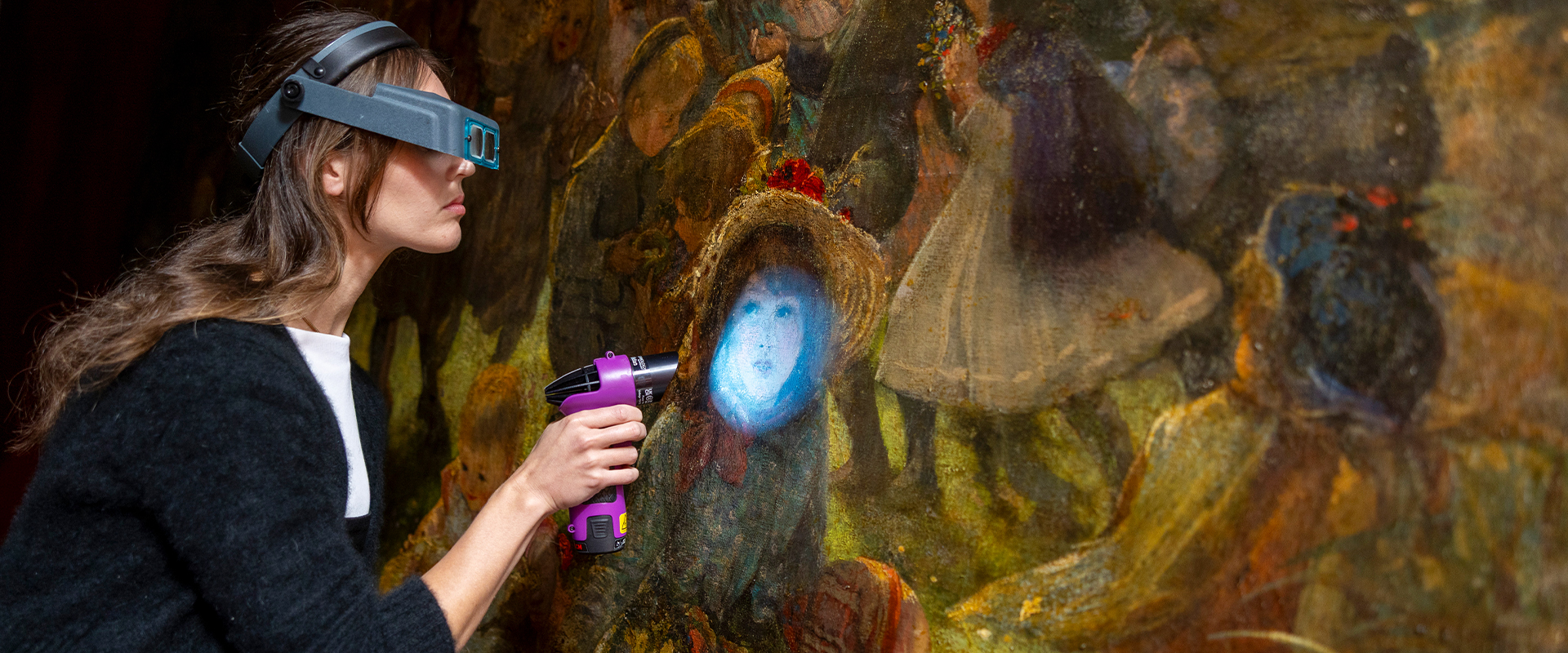
Our experienced conservators combine scientific examination, specialist technical knowledge and highly skilled practical treatment to understand exactly what is happening beneath the surface before recommending an appropriate approach.
Our painting conservators can assist with:
- Cleaning and varnish removal
- Canvas tears and punctures
- Cracks, flaking, lifting and paint loss
- Panel stabilisation
- Fire, smoke, water and accidental damage, including support during insurance claims
- Conservation assessments and condition reports
Contact our team to arrange a professional assessment and discover what may be possible for your painting. You can fill out the form below or call our team on 0207 112 7576.
Our service includes a nationwide collection and delivery service.