 WhatsApp us
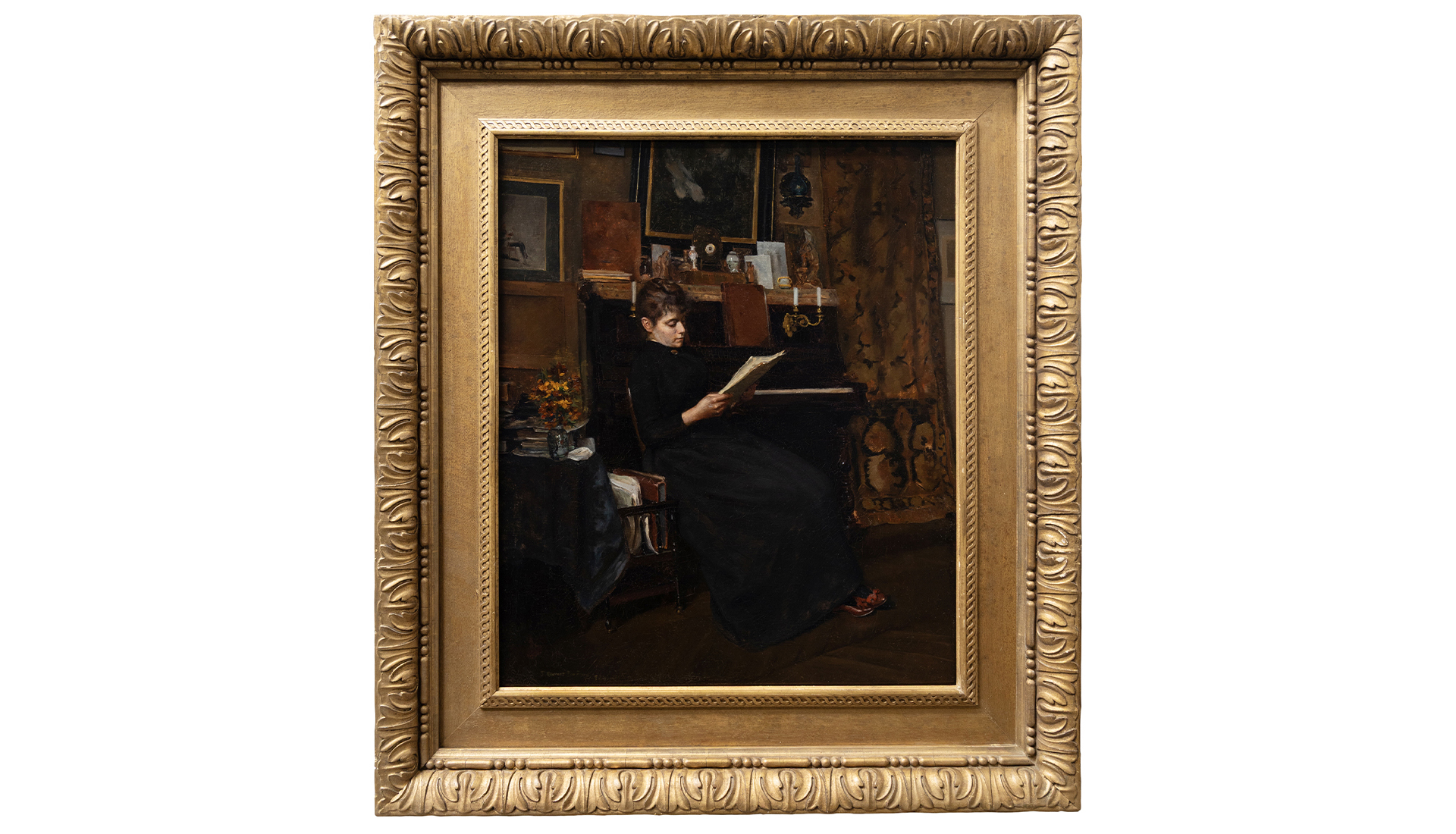
A woman sits beside a piano, studying the pages in her hands. Around her are the details of a richly furnished late 19th century French interior: books and sheet music, decorations, drapes and a collection of fine art.
Painted around 1890, L’embarras du Choix is an example of French genre painting, where scenes of everyday life explored character, interiors and social life. Loosely translated as spoilt for choice, the title adds a playful note to the scene, suggesting a sitter surrounded by the comforts of leisure, faced with the enviable dilemma of how to spend her time.
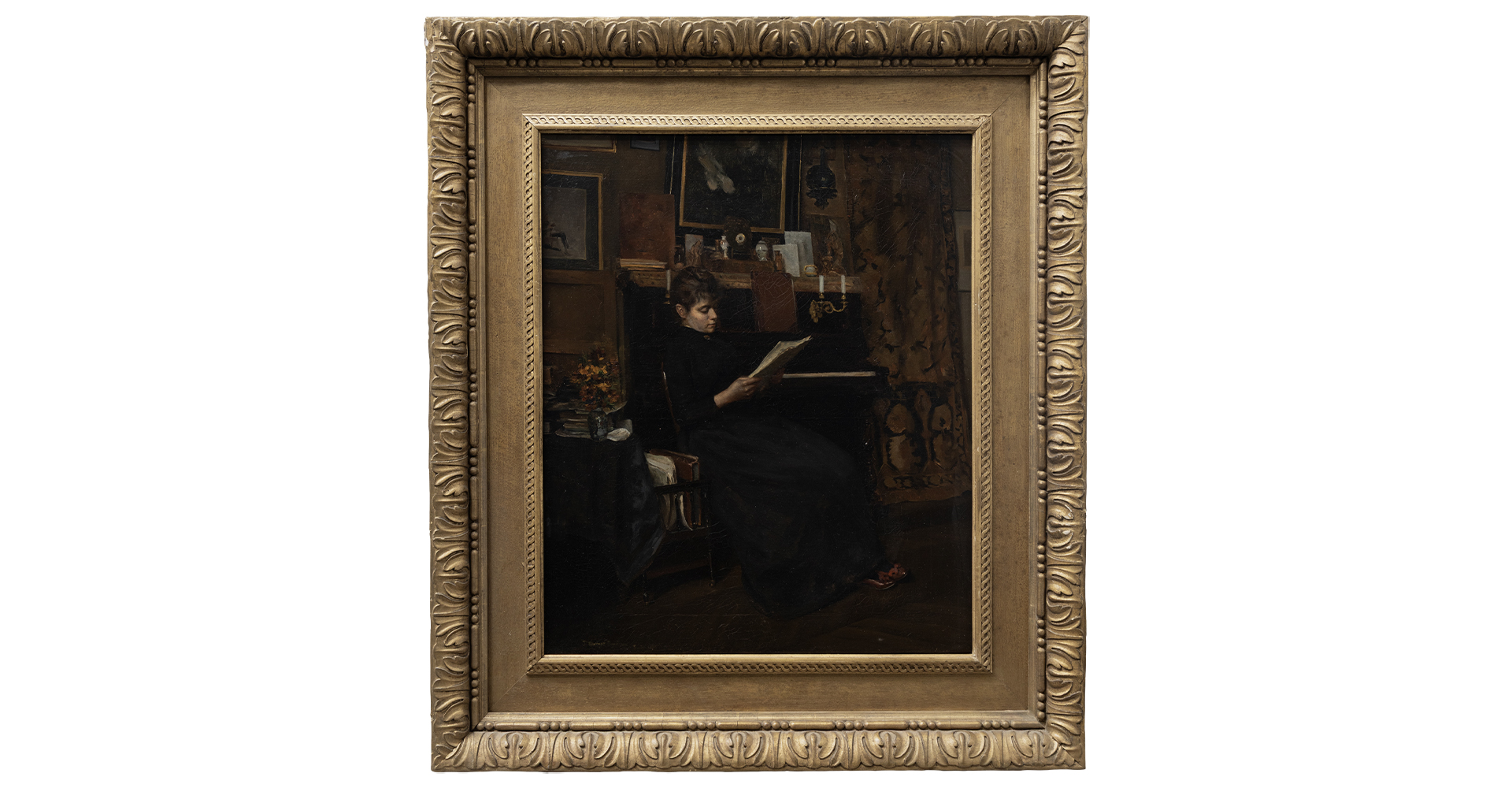
This distinctly modern preoccupation with leisure and choice reflects a changing social landscape, as an expanding middle class enjoyed greater prosperity, comfort and access to cultural pursuits.
More than 130 years of ageing, discoloured varnish and historic restoration had muted the painting’s colours and obscured many of these details. Through careful painting restoration treatments, our conservators were able to recover its tonal depth, colour and character while preserving the natural signs of age.
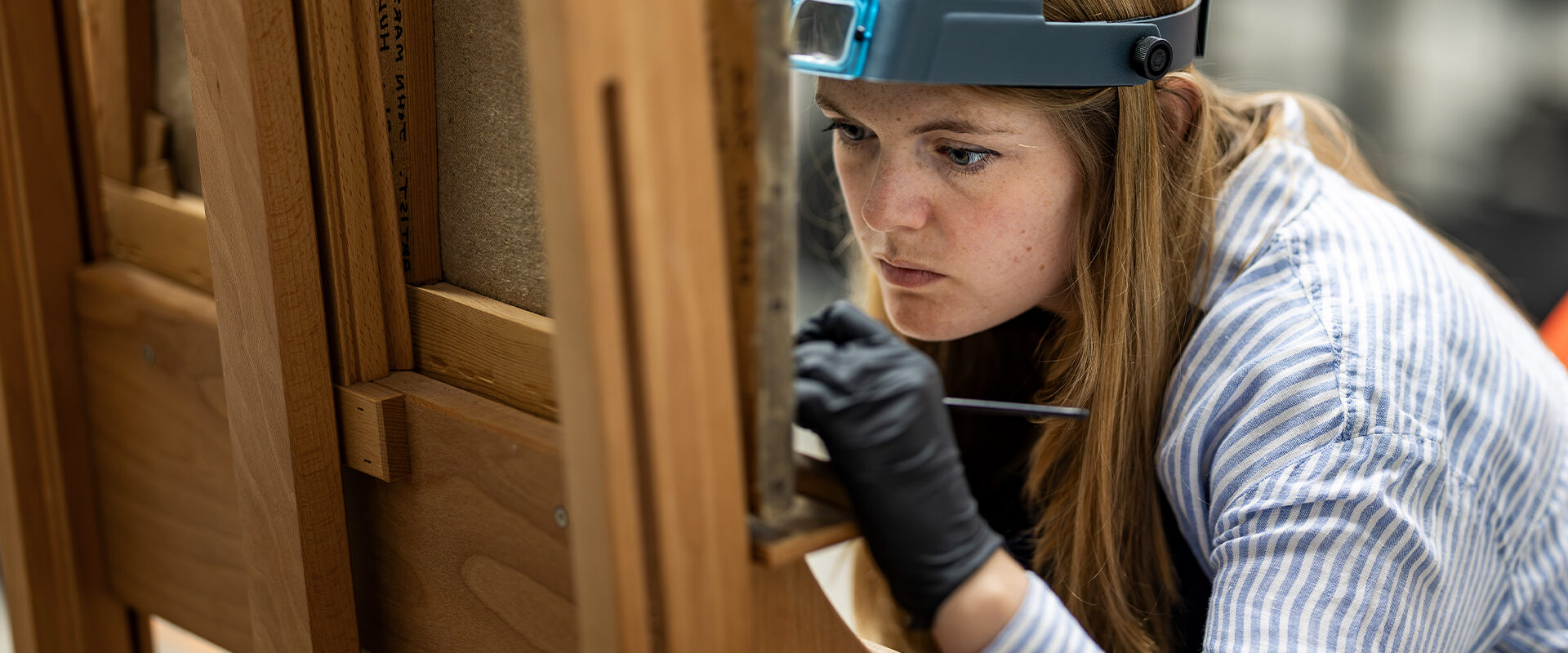 Above: a painting conservator at work in our studio
This case study explores the journey through conservation treatment and cleaning of a late 19th century oil painting. If you own an artwork that has become darkened, yellowed or obscured by old varnish, please contact our experts for a professional painting restoration assessment and free advice or fill out the form at the end of the page.
The Modern Luxury of Choice
The themes of L’embarras du Choix lie in the nature of its dilemma. Its sitter is not troubled by necessity, but by abundance – a theme that feels surprisingly modern, yet was particularly relevant to late 19th century France.
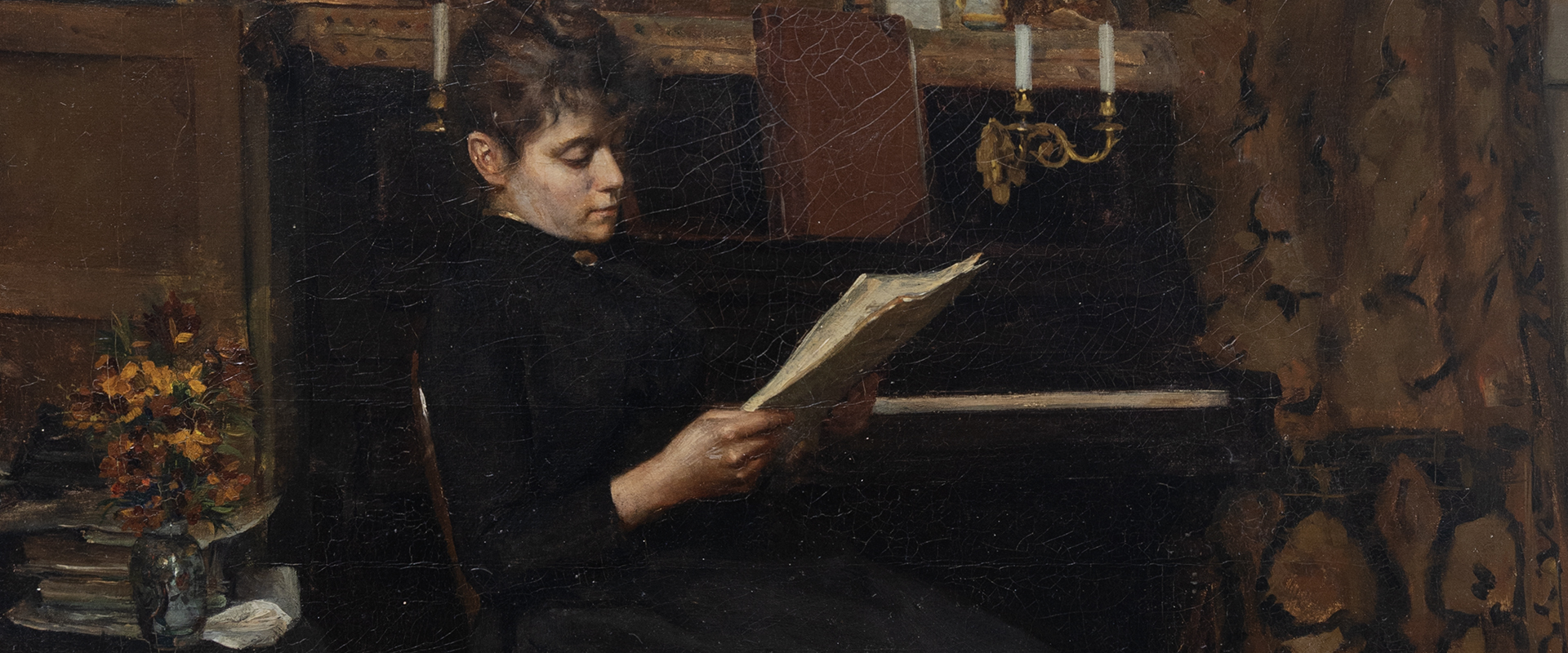 Above: a detail of the painting before treatment
During the Belle Époque, increasing prosperity among the French bourgeoisie transformed ideas of domestic life and leisure. For those with the means to enjoy it, the home became a place not only of comfort but of cultural display. Reading, music and collecting were markers of education and refinement.
Seen in this context, Bondoux’s title becomes more than a playful observation. Being “spoilt for choice” depended upon having choices in the first place. The painting reflects a society in which some had greater access to material comforts, cultural pursuits and leisure time and where deciding how to spend that time could itself become a subject worthy of depiction. Bondoux turns this social shift into a subtle joke: the privilege of choice has produced the problem of choosing.
 Above: detail of the array of decorative objects in the painting
The Effects of Time
L’embarras du Choix had remained in the client’s family for generations, having belonged to his grandfather. When they first contacted our team, the question seemed relatively straightforward: could the painting be cleaned and could its old varnish be removed?
From the initial photographs, it was clear that the composition had become darkened. The black of the sitter’s dress seemed to merge into the piano and surrounding shadows, while the richly decorated textile had lost much of its distinction. Objects receded into the gloom and the interior appeared to sit beneath a warm brown veil.
 Above: a detail of the painting’s surface
Some of this change could be attributed to the painting’s aged varnish. Traditionally, varnishes were applied to oil paintings to protect the paint surface and saturate the colours beneath, giving darker tones greater depth and enriching the overall appearance. Many traditional natural resin varnishes, however, undergo chemical changes as they age. Exposure to light, oxygen and environmental conditions can cause them to oxidise, becoming increasingly yellow or brown and altering the tonal balance of the painting beneath.
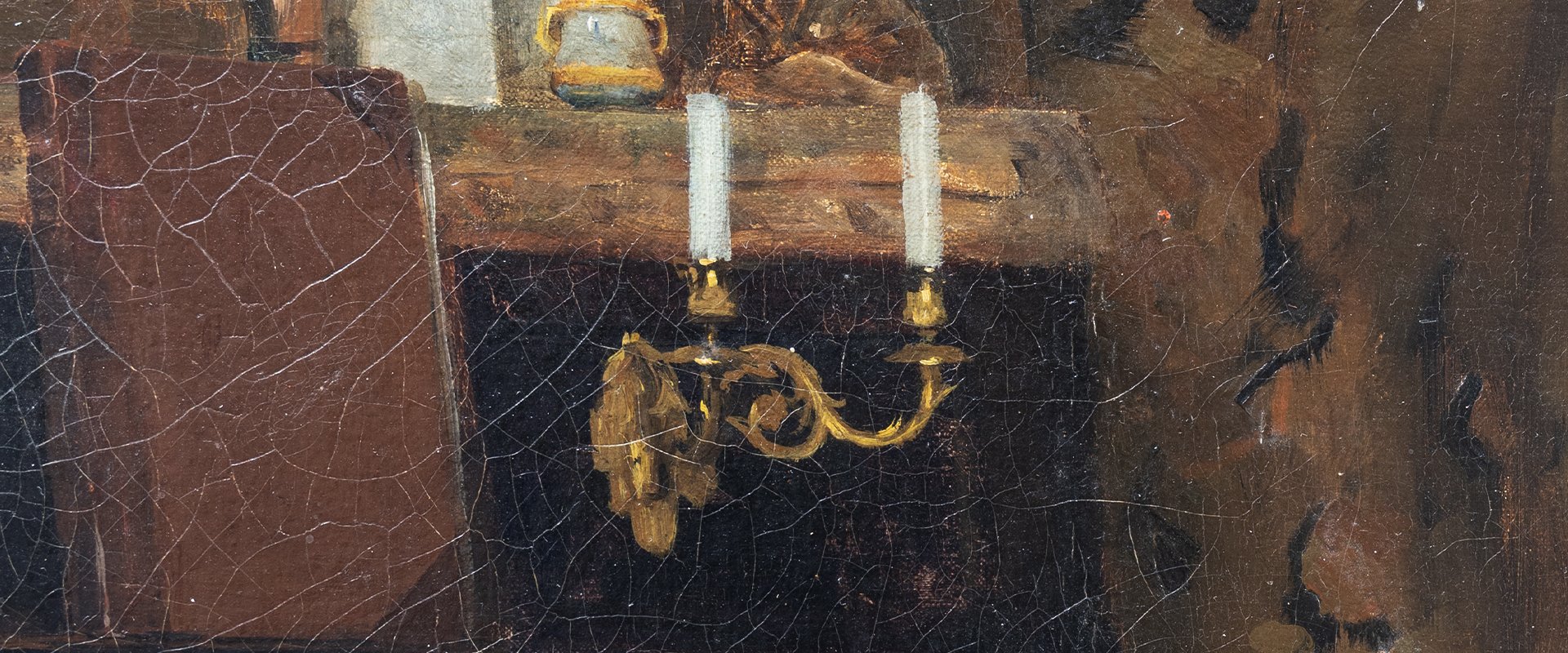 Above: a detail of the painting surface during assessment
The environment in which a painting has lived can also leave its mark. In a late 19th and early 20th century interior, soot from coal fires and fireplaces, tobacco smoke, dust and other airborne contaminants could gradually settle on the surface. Some contaminants become embedded within or adhere to an ageing varnish layer, contributing further to a painting’s darkened appearance. In this case, the studio assessment confirmed a general layer of dust across both the front and reverse, alongside lightly discoloured varnish.
Over decades, these changes can fundamentally alter how a composition is read. Subtle distinctions between dark colours disappear, cooler tones take on a warmer cast and details intended to sit within the shadows can become almost invisible.
This is why professional oil painting cleaning and varnish removal can have such a significant effect. Rather than simply making a painting brighter, careful conservation can recover the tonal relationships, colour and depth that have gradually been altered by its ageing surface.
Looking Beneath the Surface
Once in the studio, examination revealed that the painting had undergone considerable restoration during its lifetime. The canvas had previously been wax-lined, with a loose lining also covering the reverse, while extensive age-related craquelure corresponding with the stretcher bars were visible across the surface.
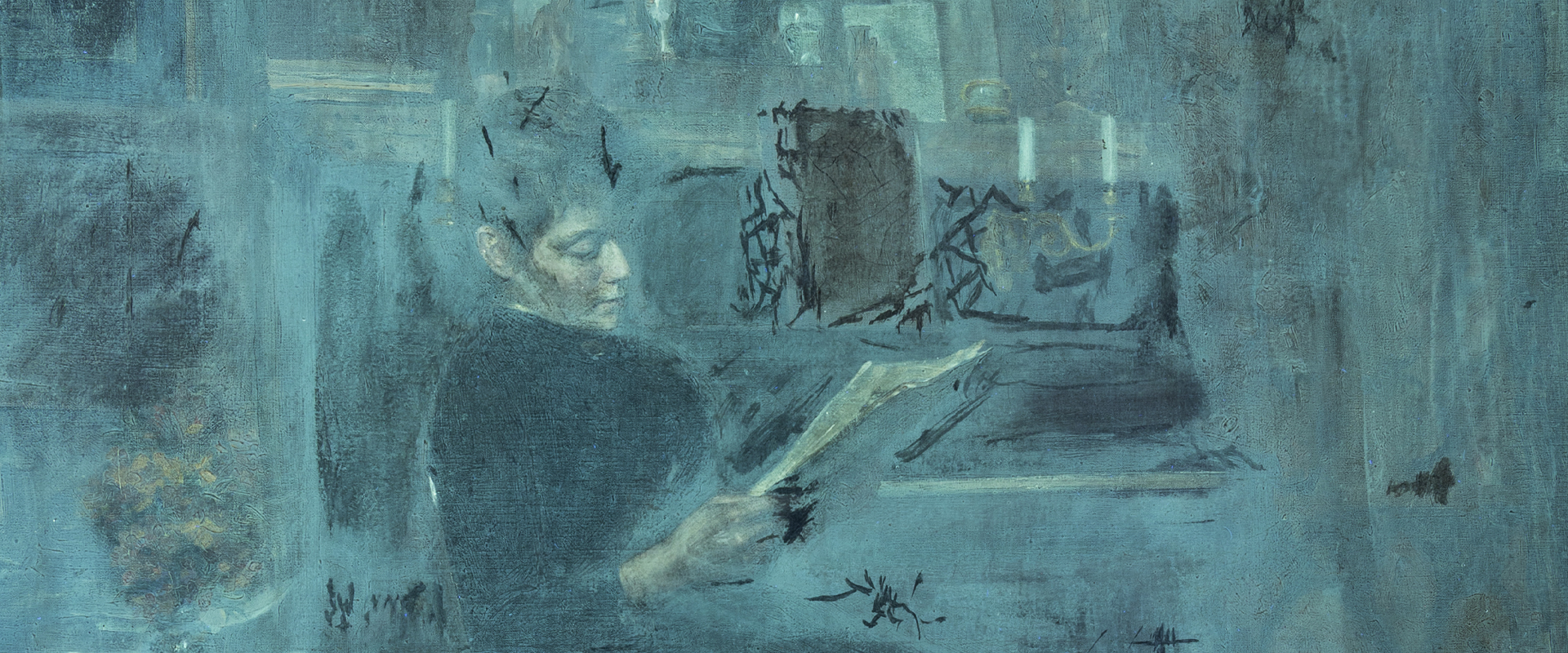 Above: the painting viewed under UV revealing areas of past restoration and aged varnish
Wax lining was once a common treatment for paintings with weakened or damaged canvases. A second canvas was adhered to the original using a wax-resin mixture, intended to strengthen the support and secure unstable paint. Although widely used during the 19th and 20th centuries, the technique is now generally avoided by conservators because wax can penetrate the original canvas and paint structure, alter the appearance of the surface and prove extremely difficult to reverse. Modern canvas conservation treatments favour more minimal, targeted approaches wherever possible.
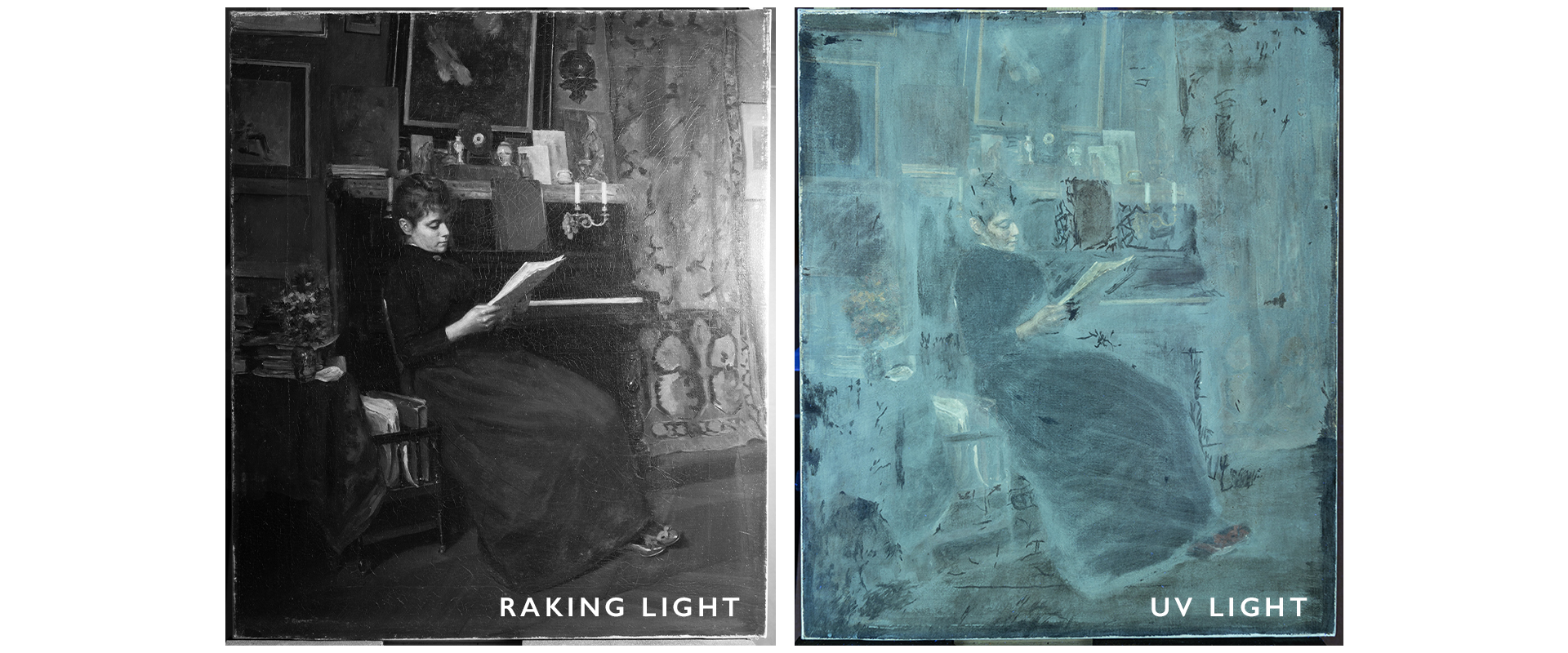
There was also evidence of extensive historic retouching, particularly across the dark floor, around the foot of the piano and near the sheet music. Previous restorers had likely applied these additions to disguise losses or damage, but over time retouching can age differently from the original paint and become increasingly visible.
Together with the discoloured varnish, these earlier interventions were beginning to disrupt Bondoux’s carefully balanced dark tones and fine details. The challenge was not simply to make the painting clean, but to understand its restoration history and determine what could safely be retained, reduced or removed.
A detailed painting condition assessment is therefore an essential first step, allowing conservators to identify previous treatments, structural concerns and changes that may not be apparent from photographs alone.
The Conservation Decisions
There is a fitting parallel between Bondoux’s subject and its conservation: both centre on choice. For our conservators, the question was what to remove, what to retain and which signs of age should remain part of the painting.
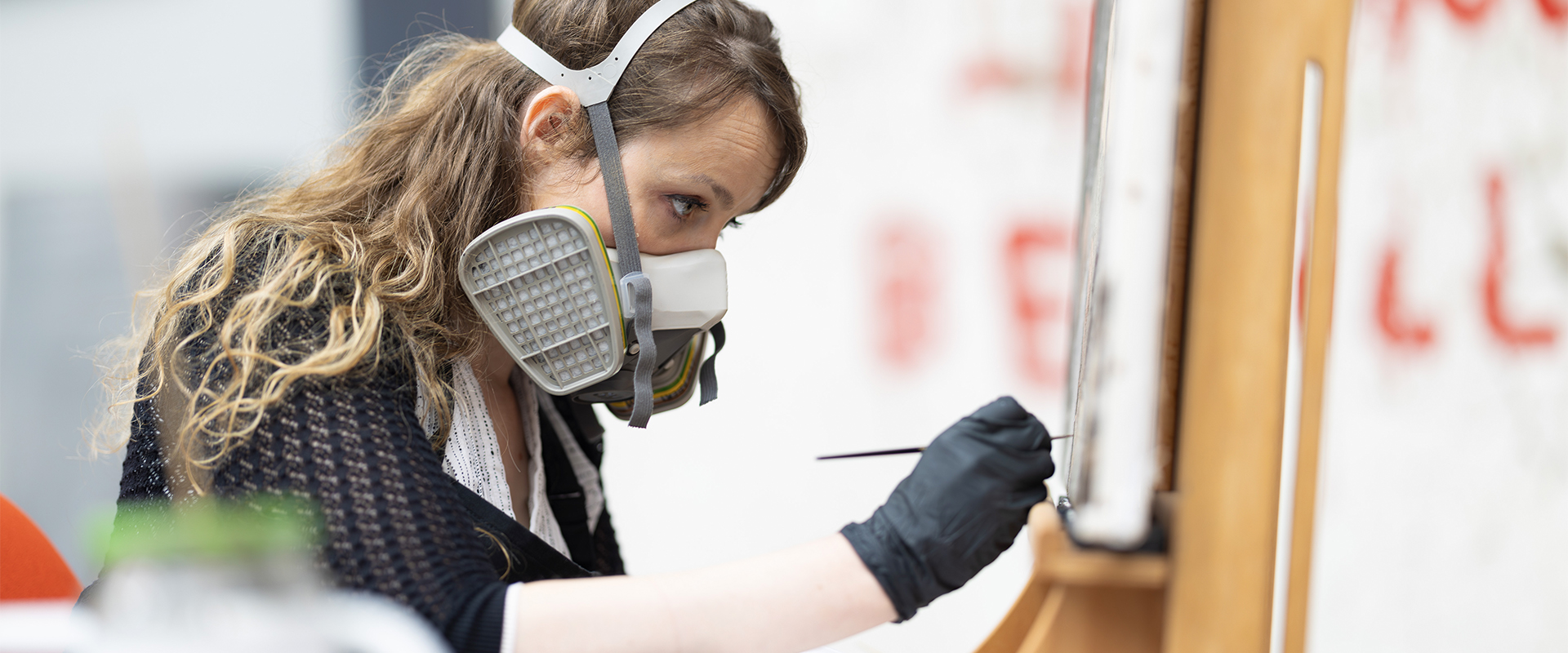 Above: a conservator working on an oil painting in our studio
Testing established that the varnish and historic overpaint could be reduced, with tailored solvent mixtures used to determine where later material should be retained, thinned or removed. Varnish removal is a controlled process, requiring an understanding of how each layer responds without compromising the original paint.
The aim was never to make the painting appear new. Its extensive craquelure and stretcher bar cracks were permanent features of its age and would remain visible after treatment.
Before work on the painted surface began, the reverse was cleaned, the canvas correctly re-tensioned and unstable areas of paint consolidated. The discoloured varnish was then carefully removed and historic overpaint addressed where appropriate.
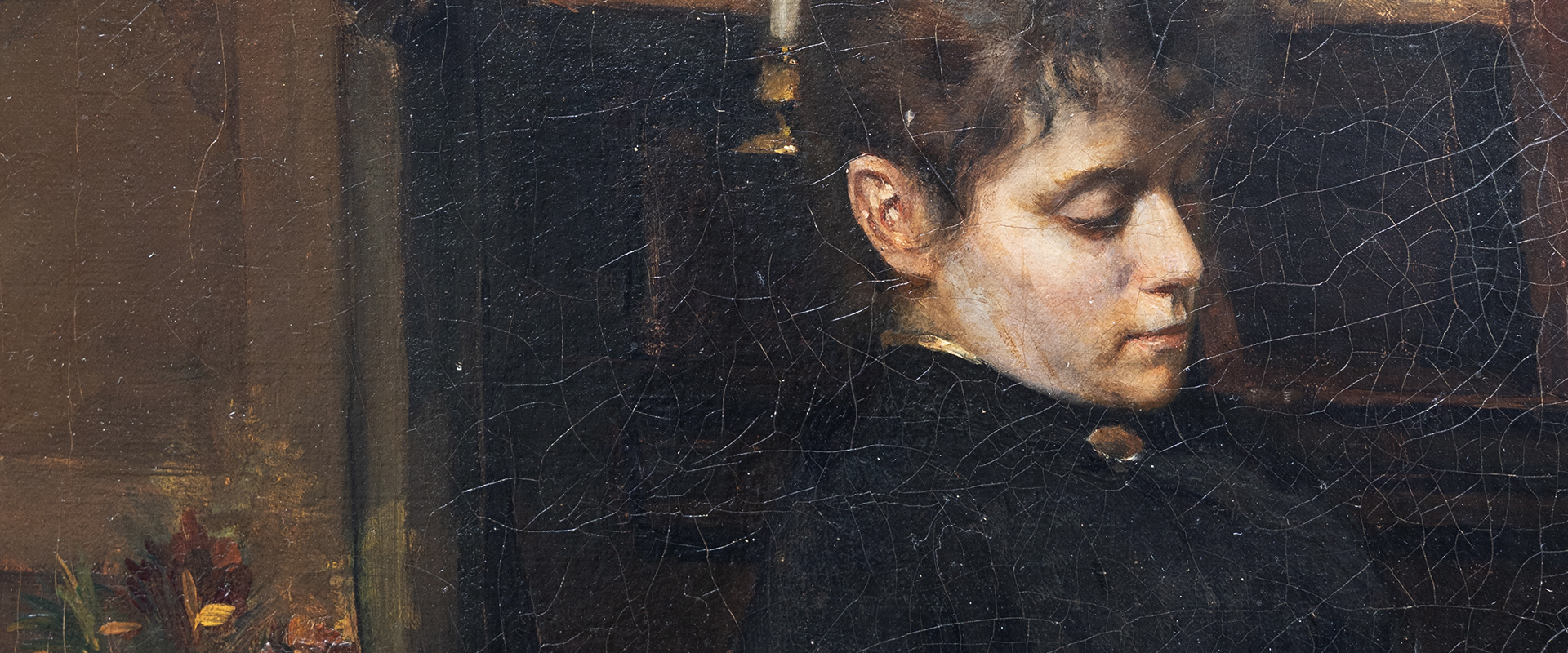 Above: detail of the craquelure on the surface
Revealing Bondoux’s Interior
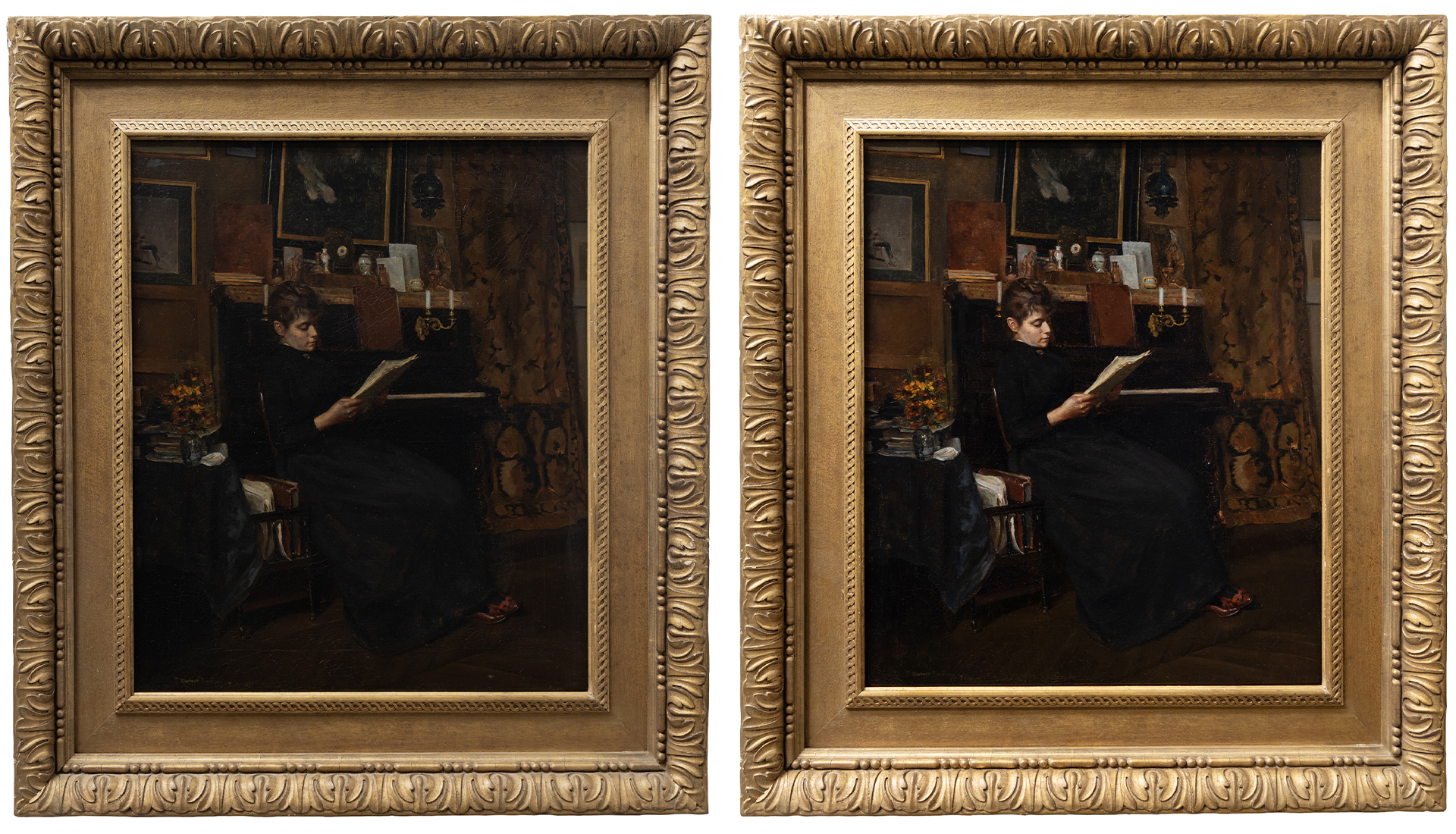
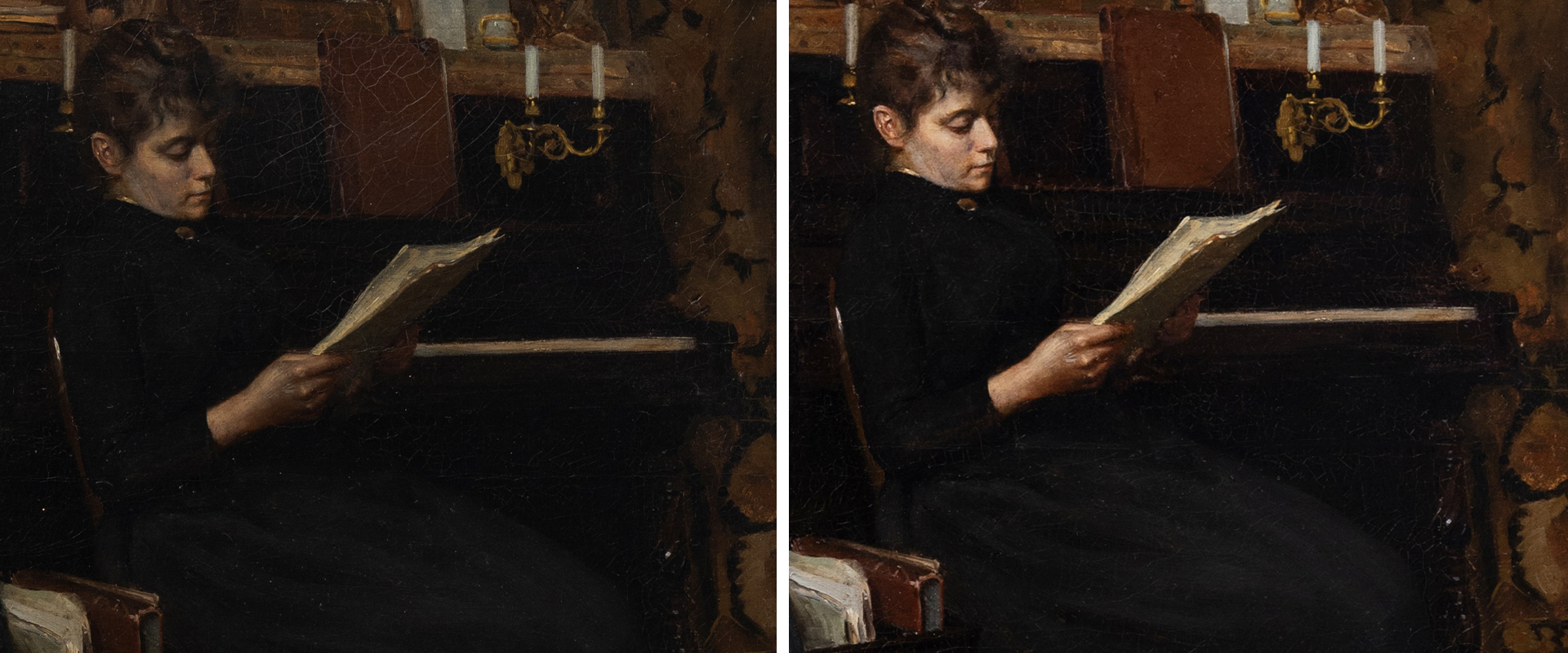
As the aged varnish and later interventions were reduced, Bondoux’s palette began to regain its distinction. The sitter separated more clearly from the piano and surrounding shadows, while her face, hands and sheet music became stronger focal points.
Details previously lost within the darkened surface also returned: the reds and oranges of the flowers, ceramics above the piano, warmer tones within the patterned textile and the small flash of red from the sitter’s shoes.
This is the purpose of professional painting cleaning and varnish removal: not to introduce new colour, but to recover the tonal relationships, depth and detail already present within the original painting.
Reintegrating Without Erasing Its History
Once the aged varnish and inappropriate historic overpaint had been reduced, an isolating varnish was applied, creating a protective barrier between Bondoux’s original paint and the conservation retouching that followed.
Areas affected by old restoration were carefully reintegrated, while visually disruptive craquelure was reduced where appropriate. The aim was not to disguise the painting’s age, but to restore visual balance while allowing its history to remain evident.
A final protective spray varnish unified the surface, completing over 12 hours of conservation treatment, including cleaning, varnish and overpaint removal, consolidation, retouching and revarnishing.
 Above: a conservator replacing an artwork in its frame following treatment
Restoring the Balance of the Composition
The transformation is perhaps most apparent in the way the composition now reads as a whole. Dark passages have regained their separation and depth, while colours and details previously subdued by the aged surface are once again distinct.
The eye moves more naturally between the flowers and books, the sitter and her sheet music, and the piano and patterned textile beyond. Small details have also regained their importance, from the warmth of the flowers to the striking red shoes beneath her dress.
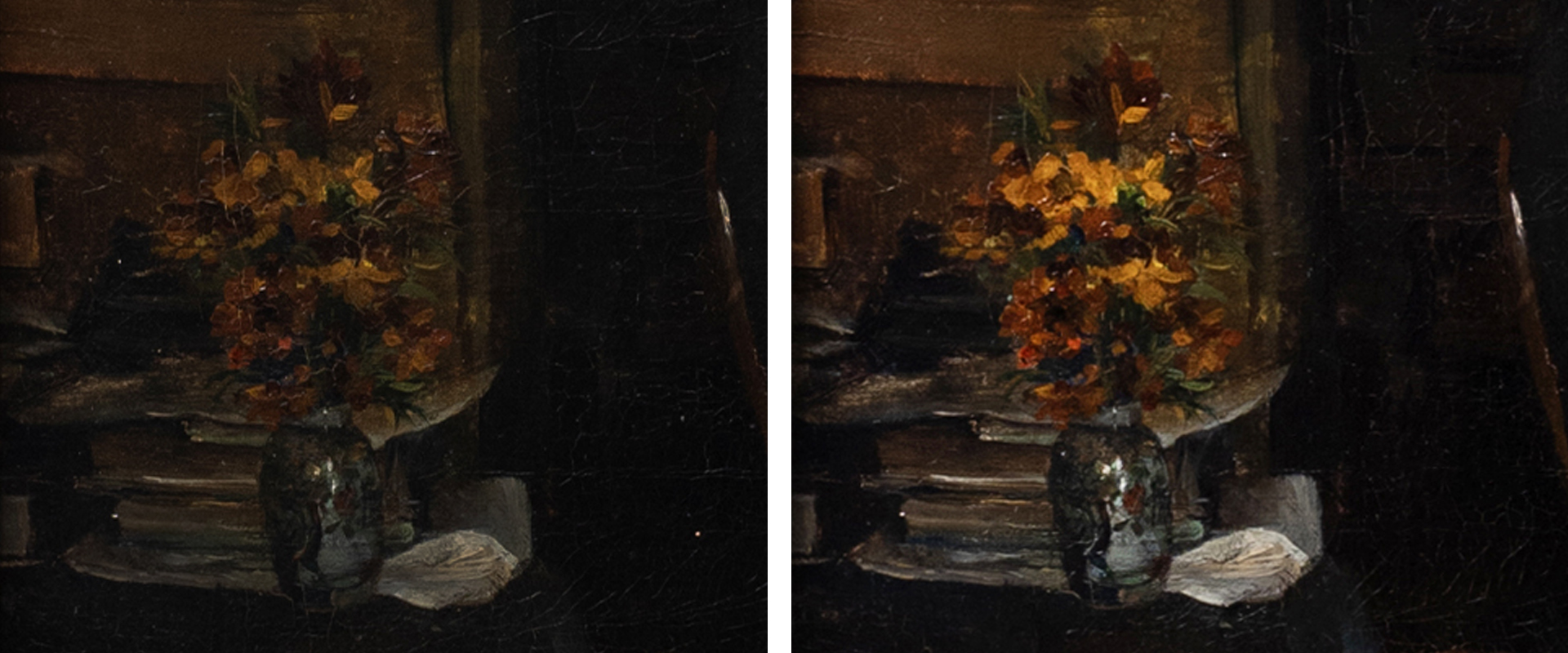
Crucially, the restoration has not removed the painting’s age. Its craquelure and evidence of earlier conservation remain part of an artwork that has existed for more than 130 years. What has been recovered is the balance of Bondoux’s composition and the details that make its narrative so engaging.
The sitter remains where Bondoux left her in 1890, surrounded by the comforts and cultural pursuits of her time, still contemplating a choice whose answer remains outside the frame.
Beyond the Interior: Jules-Georges Bondoux
The domestic world of L’embarras du Choix represents just one chapter in Bondoux’s varied career. A pupil of Jules Lefebvre and Eugène Le Roux, he exhibited regularly at the Paris Salon between 1886 and 1911.
His work later took him much further afield. In 1902, Bondoux joined archaeologist Jacques de Morgan’s 18 month expedition through Susa, Tehran, Tiflis, Batumi and Constantinople. Two monumental paintings he produced in this period have since become the subject of conservation supported by American Friends of the Louvre.
Bondoux also explored intellectual and literary subjects. The Maison de Victor Hugo in Paris holds his Victor Hugo concevant Les Rayons et les Ombres (1912), depicting Hugo imagining poetry. Like L’embarras du Choix, it turns an internal thought process into a narrative subject.
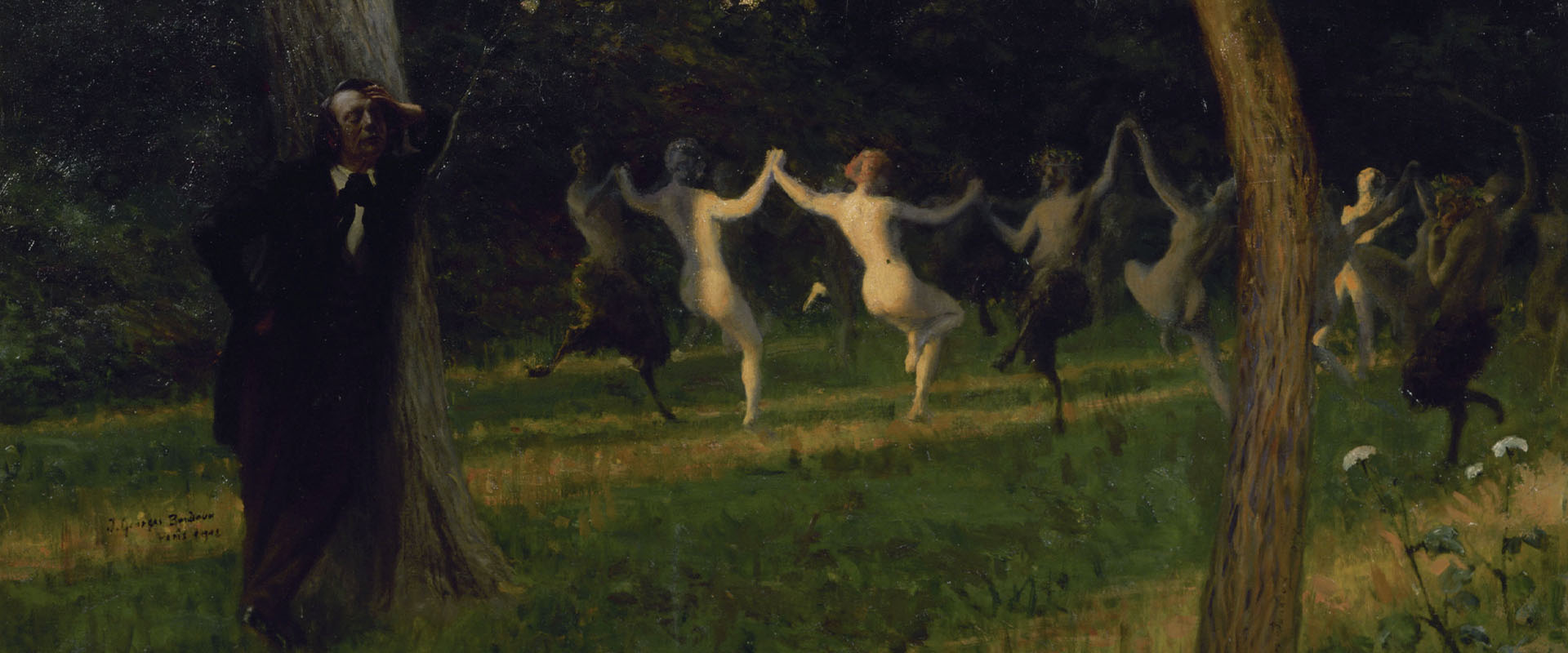 Above: detail from Victor Hugo concevant Les Rayons et les Ombres (1912)
The connection is particularly interesting given Hugo’s engagement with the social changes of 19th century France. Bondoux’s earlier painting approaches this changing society from another angle. Its title can be understood as spoilt for choice or, more evocatively, an embarrassment of riches. Her dilemma reflects a bourgeois culture in which growing prosperity for some brought greater opportunities for consumption, culture and choice.
From bourgeois interiors to archaeology and the intellectual world of Victor Hugo, Bondoux’s subjects varied considerably, but his interest in people, ideas and narrative remained.
Could Your Painting Have More to Reveal?
Darkened varnish, surface dirt, flaking paint, old retouching and previous restoration can gradually change the way an artwork looks and, as this case study demonstrates, sometimes obscure far more than we realise.
If you have a painting that has become darkened, damaged or unstable, contact our specialists for advice and a no-obligation estimate. Send photographs of your artwork for an initial assessment and discover what conservation may be able to reveal.
